Memorizing poems and changing the brain?

1 Comment

Image

Light in front of Narragansett Bay (where I am spending my week)

I seldom read only one book at a time, except when it is one of those books that I cannot put down (such as the Harry Potter or the Song of ice and Fire series). So while I am reading The Art of Changing the Brain in its paper form, I have also The End of Big on my tablet. In a way, the two books are on their appropriate platforms: the former reads best while taking notes on the side (I have not yet found a digital way to take notes that is as effective for me as the actual act of writing), and the latter has so many interesting links that having it on the tablet lets me immediately check them out.

I will eventually write my impressions on The End of Big, as it is a powerful book, covering many areas and very thought-provoking. But today I will write about a mental collision I had last night, just after I finished reading Chapter 3 of the Brain book. If you read my previous posting, this chapter is about the right balance for stimulation of both the front and the back of the barin (providing the knowledge and also acting on it). The end of that chapter, which I did not finish in the posting, is about the factors that affect this balance in a negative way, be it the amount of information perceived to be necessary (and crammed into courses), or the push toward being an innovative teaching (so most time is spent in the active testing part). I completely agree with that, as the whole idea of reading this book and in general books about learning theories was because I feel that often we educators just implement things because they are popular, not because we know How and why to use them…

So I felt validated and cozy, and before going to sleep read a bit of the End of Big book. And stumbled on the following: “My hobby for the past decade has been memorizing comments.” The chapter is dedicated how our memory has changed (for the worse) because of the existence of Google. Citing Nick Carr’s provocative question: Is Google making us stupid?,” the autor goes on saying how much he cherishes his memorized poems, and without going too deep, how he worries about the effect of radical connectivity  on our knowledge.

So I had to sit back and think for a bit. I had to memorize many poems when in high school (in Europe eons ago), and I can still recite most of them. When teaching anatomy and physiology, I require my students to memorize the normal values of blood pH, pCO2, and bicarbonate values. But for the past 2 decades, I do not think I had ever memorized or required to memorize anything, as it seemed a waste of brain power.

So I decided to do an experiment: I am very fond of Lincoln’s Gettysburg address, so I decided to memorize it. English not being my first language, it will probably take longer. I have so far managed to sentences- but they are complex sentences. “..a new nation conceived in liberty and dedicated to the proposition that all men are created equal.” I had to think of each work deeply, why exactly was this word used and not another synonym?

And as I went through each word and the exercise of putting those words in order, I had this little light bulb in my head turning on. There may be some value to memorizing after all. Especially if memorization involves a powerful intellectual processing exercise.

So very cool- to appreciate memorization via en internet guru.

Apropos Cell Polarity

Leave a comment

We started Bio620 (Seminars in Cell Biology) yesterday with a guest speaker (more to come) and a discussion of general design principles of cells, a review by Rafelski and Marshall.

Part of the discussion was about how cells become polarized, and so this morning a blog posting caught my eye. It was Elio’s (Moselio Schaecter’s) blog Small Things Considered, which you absolutely want to follow if you are into Microbiology.

picture showing auroras around the Earth poles

NASA’s Polar spacecraft captured the first-ever movie of
auroras dancing simultaneously around both of Earth’s
polar regions.

Today’s posting  refers to polarity in bacteria and, and discusses an article with some novel approaches to identify molecules associated to poles.

The title is: Polar Enchantment.

Indications of a bright future through science

Leave a comment

Indications of a bright future through science.

Looking forward Cell Bio- mitochondrial DNA linked to inflammation?

Leave a comment

As we are heading from molecular to cell biology I am starting to collect topics that may be of your interest. I just saw this today, published online in Nature (note: NU Library has the paper subscription, so for online first articles you need to wait until it comes out as a print reference, and then they are available). Seems pretty interesting, and is one more addition to the autophagy issue (cells degrade their components for a variety of reasons, among them pure recycling of defective stuff or starvation), which seems to be extremely important for cellular health. Not to mention the mitochondria issue- there seems to be some delicate interplay between mitochondria’s ability to generate ATP and the cell’s needs and abilities to use it. For now, copying the abstract and one picture.

Mitochondrial DNA that escapes from autophagy causes inflammation and heart failure

Takafumi Oka et al

Nature (2012) doi:10.1038/nature10992

Published online 25 April 2012

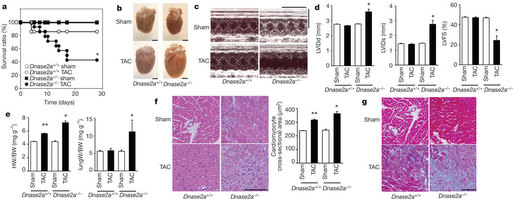
picture showing Effect of heart overload in normal and DNAse-knockout mice

Effect of heart overload in normal and DNAse-knockout mice- observe the change of size of the heart!

Heart failure is a leading cause of morbidity and mortality in industrialized countries. Although infection with microorganisms is not involved in the development of heart failure in most cases, inflammation has been implicated in the pathogenesis of heart failure1. However, the mechanisms responsible for initiating and integrating inflammatory responses within the heart remain poorly defined. Mitochondria are evolutionary endosymbionts derived from bacteria and contain DNA similar to bacterial DNA234. Mitochondria damaged by external haemodynamic stress are degraded by the autophagy/lysosome system in cardiomyocytes5. Here we show that mitochondrial DNA that escapes from autophagy cell-autonomously leads to Toll-like receptor (TLR) 9-mediated inflammatory responses in cardiomyocytes and is capable of inducing myocarditis and dilated cardiomyopathy. Cardiac-specific deletion of lysosomal deoxyribonuclease (DNase) II showed no cardiac phenotypes under baseline conditions, but increased mortality and caused severe myocarditis and dilated cardiomyopathy 10 days after treatment with pressure overload. Early in the pathogenesis, DNase II-deficient hearts showed infiltration of inflammatory cells and increased messenger RNA expression of inflammatory cytokines, with accumulation of mitochondrial DNA deposits in autolysosomes in the myocardium. Administration of inhibitory oligodeoxynucleotides against TLR9, which is known to be activated by bacterial DNA6, or ablation of Tlr9 attenuated the development of cardiomyopathy in DNase II-deficient mice. Furthermore, Tlr9 ablation improved pressure overload-induced cardiac dysfunction and inflammation even in mice with wild-type Dnase2a alleles. These data provide new perspectives on the mechanism of genesis of chronic inflammation in failing hearts.


BioTechniques – Last Days of Exome Sequencing

Leave a comment

This is really good and pertinent to the class- it compares the pros/cons and costs of exome versus whole genome sequencing.

BioTechniques – Last Days of Exome Sequencing.

Searching for information

Leave a comment

So you have an idea of what you want to study-explore-research. You think that it passes the “So what” test. Now you have to look for information.

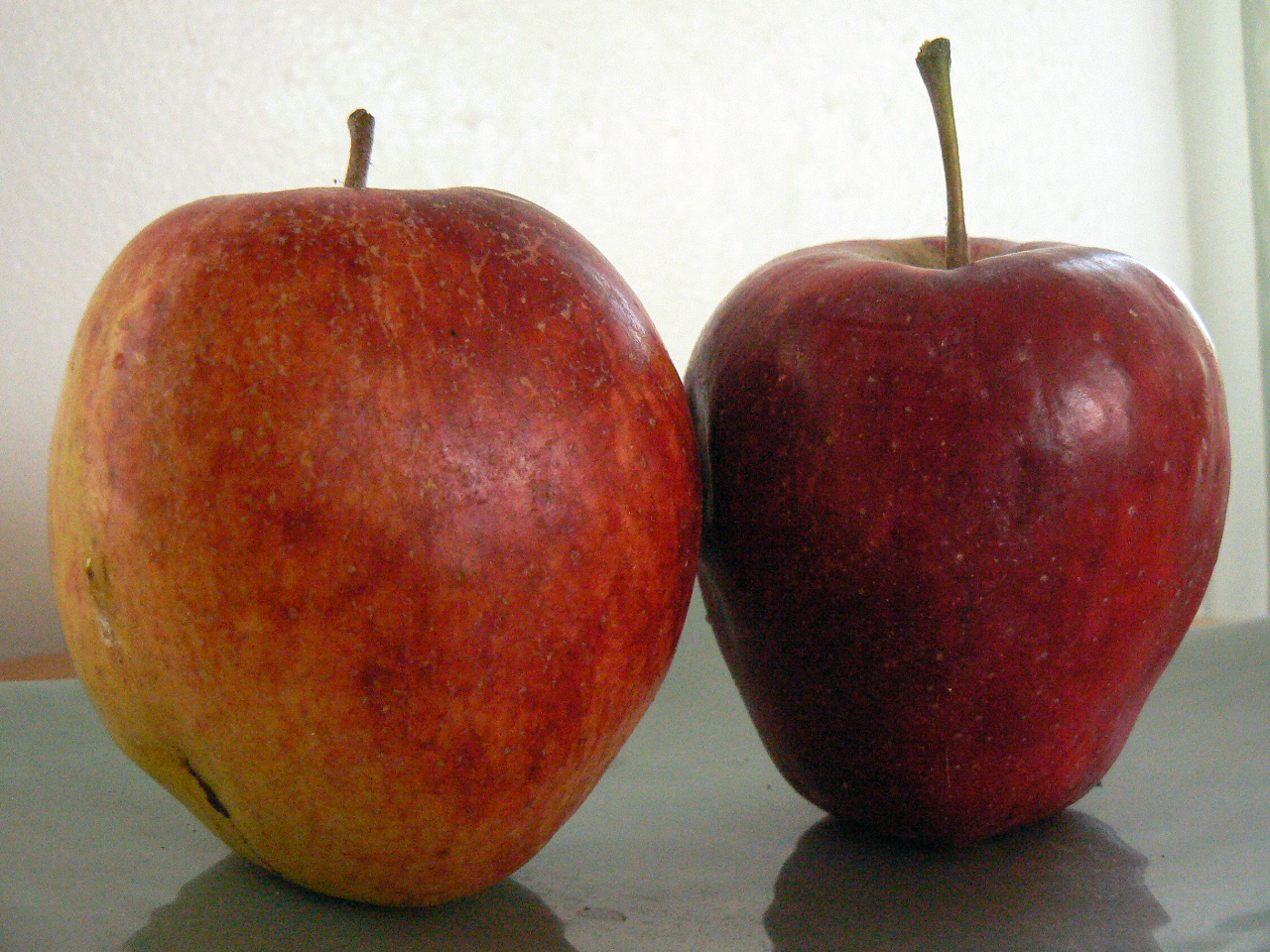
picture showing apples

In search for the apple of knowledge

What you do?

I am sure most of you (and even me!) will google up the word. Very probably you (and I) will use Wikipedia as a starting point. Nothing wrong with it…as long as it is the starting point.

Here are some more strategies:

  • database search: there are plenty of databases, one of the most used being Pubmed (Entrez) but there is Library of Congress and many others. If in doubt talk to the librarians. They will help you not only to choose databases, but also to establish searches based on keywords or other criteria.
  • Crawling the story of the paper: most topics will have a few labs that are known and prestigious regarding the topic, and you want to identify them quickly. Then you start the detective work backwards and laterally. Backwards means going backward in time with the papers. Chances are that the description of the methodology or model used in all papers is tucked away in a paper 20 years ago. Laterally means looking for other people involved in this research via collaborations, sharing resources etc. Even if the sharing is purely methodological, it is always worth to know what people do with the same system using a certain model.
  • Be aware of controversies and rivalries. This is harder to spot if you are outside the field, but look for any statement regarding differing opinions or experiments that cannot be repeated. You may find a completely different view of the topic.
  • High impact journals are usually the most respected source of knowledge. However do not underestimate the information coming from other sources. Besides controversies, there may be sheer practical reasons for scientists not to travel to a certain prestigious conference or publishing in a certain paper, such as…money.
  • 21st century tools: explore the social media. See if any of the main scientists related to the topic has a blog or is on Twitter. If so, be sure to follow them and make intelligent comments on their postings. Who knows, maybe they will notice you and share some of their nuggets of wisdom (or inside information).
  • San Diego is a great place for biosciences. Every week there is probably a world-renown expert giving a seminar somewhere in La Jolla. Many of them are open to the public, some require registration but not fees, and some may require something to pay. You can have the chance to actually see and listen to the main expert in your topic, how cool is that! Ok how do you know about the seminars? There are some aggregator sites such as Biocom, and San Diego Biotech network, the latter actually has a long list of other networking groups in the region. You may need to visit your favorite institutions’ websites for seminar schedules.
  • San Diego is also a great conference place. Many big name events happen in the Convention Center. And many events require volunteers. Or offer discounted registration for students. So look up the conference schedules and see if you can volunteer to any of those! Once inside, you can probably use some of your time to wander around and maybe corral your favorite scientist.
  • AAAS is a great organization, and their conferences are usually very affordable for students.

While you can obviously find lots of information from paper articles, there may be changes happening in relationship to your topic. Exciting preliminary results, several results heralding a paradigm change, new emerging technologies…that information is priceless to have a good sense of what is going on in the filed. Therefore I encourage you to think out of the box regarding the search for knowledge. The closer you are to the source, the more recent and probably relevant the information.

Good luck in your quest!

My favorite orthologs

Leave a comment

Human TNF

This human TNF gene encodes a multifunctional proinflammatory cytokine that belongs to the tumor necrosis factor (TNF) superfamily. This cytokine is mainly secreted by macrophages. It can bind to, and thus functions through its receptors TNFRSF1A/TNFR1 and TNFRSF1B/TNFBR. This cytokine is involved in the regulation of a wide spectrum of biological processes including cell proliferation, differentiation, apoptosis, lipid metabolism, and coagulation. This cytokine has been implicated in a variety of diseases, including autoimmune diseases, insulin resistance, and cancer. Knockout studies in mice also suggested the neuroprotective function of this cytokine.

For a recent review of the human TNF superfamily see Aggarwal et al, 2012.

TNF superfamily members include the cytokines: TNF (TNF-alpha), LT (lymphotoxin-alpha, TNF-beta), CD40 ligand, Apo2L (TRAIL), Fas ligand, and osteoprotegerin (OPG) ligand. These proteins generally have an intracellular N-terminal domain, a short transmembrane segment, an extracellular stalk, and a globular TNF-like extracellular domain of about 150 residues.

TNF superfamily structure

They initiate apoptosis by binding to related receptors, some of which have intracellular death domains. They generally form homo- or hetero- trimeric complexes.TNF cytokines bind one elongated receptor molecule along each of three clefts formed by neighboring monomers of the trimer with ligand trimerization a requiste for receptor binding.

Orthologs

TNF is highly conserved among mammals, with over 90% homology in primates. It is highly homologous to the murine (mus musculus TNF, accession number NP_038721.1), showing a 79% homology.

An initial search for orthologs did not bring many hits. I kept combing the literature and found a reference to a molecule called Eiger in Drosophila and another reference to a TNF-like molecule in the sea urchin. Then I kept mining and found references to TNF in fishes and amphibians.

<I have to make a philosophical pause here. Scientists are usually very specialized in their fields, a necessary requirement. Specialization comes often with complete blindness to other disciplines or areas. So I confess that during all my years of researching TNF I did not look further than the “TNF is highly conserved in vertebrates” mantra, so focused I was on human TNF and human diseases associated to TNF. It was only when writing my thesis that I ventured into reading more in detail about other organisms, as many mechanistical details of TNF pathways came from comparing immune pathways in different organisms, particularly in Drosophila. So I am glad to say that although I chose TNF as an example of this assignment because I thought it would be slam-dunk to prepare, I have actually learned a lot of cool information that was new for me.>

Finally I have arrived to this article by Wiens and Glenney, 2011, which I just ordered through ScienceDirect, so I do not have access to it…but here is what the abstract says:

The tumor necrosis factor superfamily (TNFSF) and the TNF receptor superfamily (TNFRSF) have an ancient evolutionary origin that can be traced back to single copy genes within Arthropods. In humans, 18 TNFSF and 29 TNFRSF genes have been identified. Evolutionary models account for the increase in gene number primarily through multiple whole genome duplication events as well as by lineage and/or species-specific tandem duplication and translocation. The identification and functional analyses of teleost ligands and receptors provide insight into the critical transition between invertebrates and higher vertebrates. Bioinformatic analyses of fish genomes and EST datasets identify 14 distinct ligand groups, some of which are novel to teleosts, while to date, only limited numbers of receptors have been characterized in fish. The most studied ligand is TNF of which teleost species possess between 1 and 3 copies as well as a receptor similar to TNFR1. Functional studies using zebrafish indicate a conserved role of this ligand–receptor system in the regulation of cell survival and resistance to infectious disease.

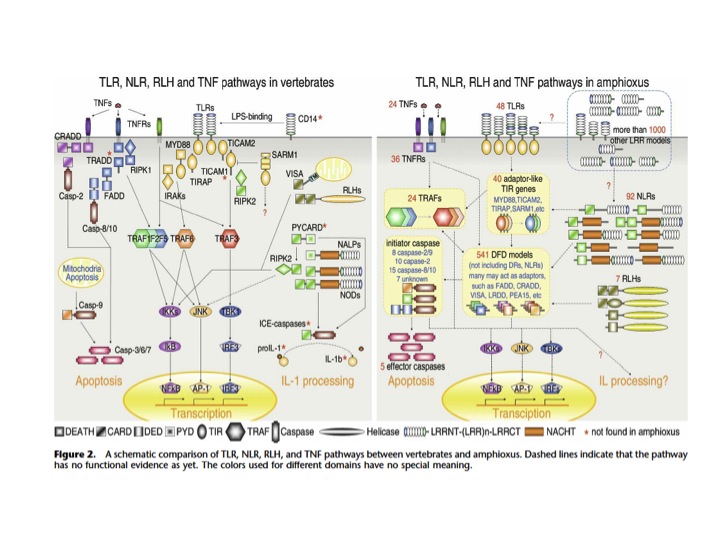
I need to show this- a comparison of the vertebrate and the amphibious immune system, copied from Huang’s article. See TNF to the left of both.

Slide showing a comparison between amphibian and vertebrate immune systems

Comparison between amphibian and vertebrate immune systems (from Huang et al, 2008).

Well, I have to stop here…but I hope you see my point of the importance of narrowing down your topic, as it always expands as you start digging!

I hope you undertand a bit the point of the past 2 assignments: we are looking for a protein related to a function. The structure of the protein is often related to its function- and we have had the chance to see different proteins, from transcription factors to toxins, enzymes, and hormones. Take a pause and look at the function- how specific it is? That will relate directly to how conserved that gene is going to be- you would expect a protein involved in some essential and widespread metabolic function to go back earlier in phylogeny compared to a protein associated to a more specific function. In my particular example, TNF is part of the immune response, so it is mainly described for vertebrates particularly mammals. But as you see from the abstract above, you see the beginnings going back to Arthropods.

Conserved features

Trimer interface, which is a conserved ring of hydrophobic residues; aids in self-assembly of monomers.

Receptor binding site. TNF ligands share a common structural motif, the TNF homology domain (THD), which binds to cysteine-rich domains (CRDs) of TNF receptors. CRDs are composed of structural modules, whose variation in number and type confers heterogeneity upon the family. Protein folds reminiscent of the THD and CRD are also found in other protein families, raising the possibility that the mode of interaction between TNF and TNF receptors might be conserved in other contexts

How to embed videos and the kitchen sink

Leave a comment

Let me start saying that I am the typical person who does not read instructions. Mea culpa. It has brought  many issues and hiccups for me, on the other hand I am usually pretty quick in figuring out the way things work…although it may not be the BEST way.

So, I recommend that you do not follow my example and read or watch the instruction materials of everything you do, particularly this blog. That said, here is some insight that you may already know, but just in case…

I see that most of you have inserted pictures, which is not that difficult as you use the little camera icon to the right of Upload/Insert on the top. Videos may be a bit trickier.

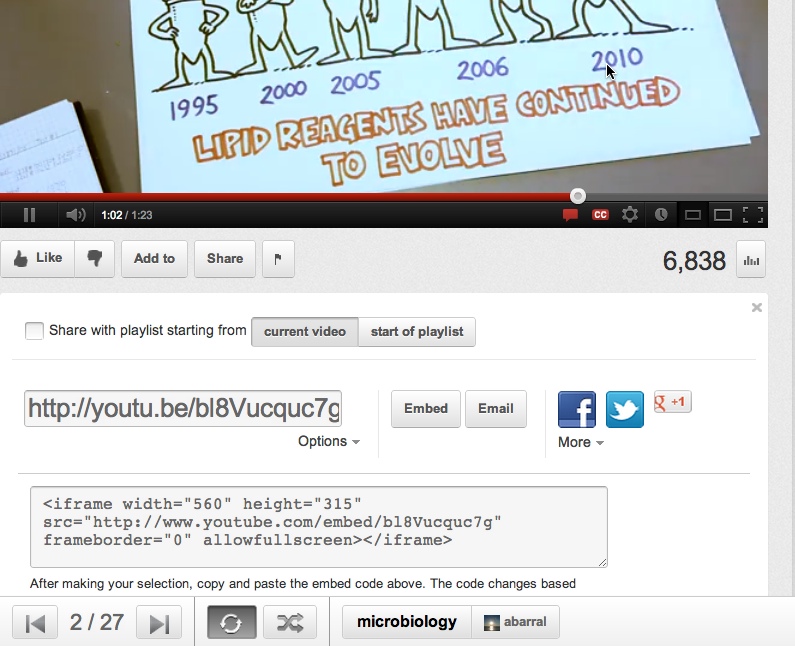
Let’s say you are in Youtube. Click on the Share button and then click again on Embed. A code will come up, which is already highlighted- so you can copy directly using the keyboard shortcuts Ctrl-C (win) or Command-C (Mac).

It looks something like this:

< iframe width=”560″ height=”315″ src=”http://www.youtube.com/embed/bl8Vucquc7g&#8221; frameborder=”0″ allowfullscreen></iframe >  NOTE I had to put a space between the first/last bracket and the rest of the text otherwise it would embed right away

Screenshot of the embedding process.

How to find the embed code in Youtube

Now paste the code into your post. Seems like WordPress will embed your code right away. My experience with other sites is that you have to embed the HTML code into the HTML window upper right tab by Visual). So use the Preview button to the right of the editing panel and check. If the thumbnail comes out, fine. Otherwise you may want to click on the HTML tab to get into the coding window and paste the code there. Once you get back to Visual you will see a thumbnail outline.

Usually that is all what you need. If by any chance you are embedding something that comes out too big, you may go back to HTML and look for the words height and Width, and the numbers after them. The rule is that you change them both the same way (half them, for example).

Voila, ready to post! This particular video is about transfections, a quickie illustration of a procedure we will be talking next week.

Re kitchen sink: I just realized that clicking on the rightmost little icon of your editing panel (Show/hide kitchen sink) opens a whole range of options I have been missing, such as styles, text colors, and other goodies.

The procedure if basically the same for Blogger- copying the Embed code and pasting it into the HTML window.

Do you have any other insight about WordPress or blogger? Please share 🙂

Looking forward seeing your protein postings!

Quick tutorial for Chi square in Excel.

Leave a comment

This is a tutorial for example 22.1, p.468 of Zar. Sorry, my cat is meowing in the background.
http://www.kaltura.com/index.php/kwidget/wid/_408291/uiconf_id/5428202/entry_id/1_ut5tqk58

What have I gotten myself into?

Leave a comment

I cannot really keep up even with my first blog and now I am getting another one?

Well there is a reason for it, and it is that I will be teaching a graduate level course in two weeks (Molecular Biology for a Masters in Biology Program) and I want my students to blog and have a website.

I already know Blogger and lots of people prefer WordPress. So what the heck, I am trying this one out.

Just playing around for today. Still deep in the readings for the class. I know what I want…but it needs to be written down.

I wish I was just like Mozart…writing down, no corrections, the ideas in his head…

Newer Entries

CUREing Ocean Plastics

STEM education exploring ocean plastic pollution

about flexible, distance and online learning (FDOL)

FDOL, an open course using COOL FISh

Main Admin Site for the WPVIP multisite

This multisite hosts public sites for Parse.ly and WordPress VIP

#Microjc

An Online Summer Book Club of Science

barralopolis

Teaching and learning reflections around science education

Disrupted Physician

The Physician Wellness Movement and Illegitimate Authority: The Need for Revolt and Reconstruction

The Blog of Author Tim Ferriss

Tim Ferriss is the author of five #1 New York Times bestsellers and host of The Tim Ferriss Show podcast.

Here is Havana

A blog written by the gringa next door

Storyshucker

A blog full of humorous and poignant observations.

Jung's Biology Blog

Teaching biology; bioinformatics; PSMs; academia, openteaching, openlearning

blogruedadelavida

Reflexiones sobre asuntos variados, desde criminologia hasta artes ocultas.

Humanitarian Cafe

Think Outside the Box

Small Pond Science

Research, teaching, and mentorship in the sciences

Small Things Considered

Teaching and learning reflections around science education

1 Year and a 100 Books

No two people read the same book