Why does Twitter work for me?

3 Comments

Science tweets galore!

Although I have tried numerous times, both “formally” as part of professional development chats and informally, few of my colleagues or friends have adopted Twitter. I have noticed misgivings and suspicion about “being on Twitter,” and no explanations or examples have worked to change that perception. I understand the misgivings- as my friend and mentor Michelle Pacansky-Brock knows, I was extremely suspicious about the public nature of Twitter when she introduced it to the Building Online Community course. The fact that I embraced it afterward and it has remained one of the few social media outlets I follow publicly is pretty telling.

Blog writers and readers love lists, so here comes a short one top off my head about why am I on Twitter:

  1. Learn about news first-hand and in real-time.
  2. I get “curated” news from different point of views, directly in my feed (more later).
  3. Make new connections and friends.
  4. Learn about what is going on at professional conferences I cannot attend.
  5. Ask for and receive advice.
  6. Complain about or praise services- I usually receive lightning-speed responses from vendors.
  7. Provides a virtual “water-cooler” environment. Not all is serious and professional. However the 140 character limit keeps chatting under control.

Let me give a quick and recent example of point #2 regarding curated news. A few days ago, namely January 7, Nature magazine published an article about the discovery of a novel antibiotic using a very creative technique to culture soil microbes (of which the majority are impossible to culture in the lab with traditional methods). The article was picked up very quickly by many mainstream media outlets and was heavily publicized over the next few days.

How did I learn about the article? Through Twitter.

I am not sure which was the first tweet that caught my attention, but I do know that is was in the evening or night. And it was not Nature journal’s account’s tweet that I saw, but noticed a flurry of activity among a number of microbiologists, geneticists, and metagenomics experts that I follow. They were referring to the article in the way experts do-  commenting, asking questions, expressing doubts and/or enthusiasm. Soon knowledgeable science writers joined (think Ed Yong) and by the end of the night I had a pretty good idea not only what the breakthrough was about, but also many of its highlights and also limitations.

Next morning the article was everywhere in the news outlets. I received the article by email from friends and colleagues and was asked about it directly. It is a great way to motivate students who do soil research in their courses (as we do), and also raise awareness of the issues with antibiotic resistance.

Let’s say that I was not on Twitter. I might have seen the article if I was the kind of person who reads Nature fresh off the press (which means having full-text online access from home- I don’t). Most probably I would have seen it at the same time as the general public, so I would had to go and read the article first to know what was it about (with all due respect, but I do not trust any press conference about a scientific discovery to get it 100% right). With my knowledge of microbiology and some idea of metagenomics, I would have probably come up with a few opinions and ideas of my own. As I am not surrounded at work with experts in the field (I am at a mainly teaching institution), I would have missed the opportunity to discuss this in person. All in all, to acquire the same knowledge that I got reading at night the Twitter feed of a few selected experts in the field may have taken days or even weeks for me.

Add to this the fact that I am still privileged: I have access to journals through the university library, and I can connect with other experts albeit not as fast as if I was in a top tier institution. Imagine the situation of those who cannot: either as an adjunct disconnected from campus life, or for academics in countries where access to information is more limited.

In summary, Twitter, with limitations of course, allows anybody with internet access to learn from experts and join enlightening and educated conversations. Dear Readers, have you succeeded to get your fellow scientists and colleagues join Twitter? If so, please share how you did it- thank you!
Apropos gut sense and dots

Leave a comment

Today I was preparing one of the live chat sessions I do in my online biology class. Part of it was to clarify an assignment, basically a research project on a topic, and I was stressing the importance of being focused and keeping it deep but simple.

I googled “Steve Jobs quotes” to find the exact wording of the “Simple can be harder than complex” quote. Found a number of other quotes and could not resist reading them.

This thought expresses so much nicer what I tried to say in yesterday’s posting:

“Again, you can’t connect the dots looking forward; you can only connect them looking backwards. So you have to trust that the dots will somehow connect in your future. You have to trust in something — your gut, destiny, life, karma, whatever. This approach has never let me down, and it has made all the difference in my life.”

That commencement speech was indeed so special.

via Text of Steve Jobs’ Commencement address (2005).

Throwback Thursday and following the gut instinct

Leave a comment

During my Ph.D. thesis defense.

During my Ph.D. thesis defense.

(Note: This post was scheduled for yesterday, but I postponed it due to the tragedy in Paris)

In a previous posting I expressed a resolve to ignore the siren song of “cool new things” in order to focus better on my priorities. That is solid and useful common sense. However, in my personal experience, many of the most life-changing opportunities came out of the blue and I have learned to “listen to the universe” for clues. Take for example the fact that I came to do my postdoc in the States. It all started by a simple question the evening of December 6th 2001, during the formal celebratory dinner of my Ph.D. thesis defense. My opponent, a renowned cancer immunologist and I were chatting about my future plans. I explained that I had a postdoctoral gig lined up in Spain. It was related to my field of interest, it would allow me to be close to family and friends, and also to give my son a  Spanish-speaking environment for a change.

“Have you considered San Diego?” he asked.

I looked at him. Earlier that day, he and the tribunal grilled me for hours in the Swedish tradition of a Ph.D. thesis defense. After the official announcements and champagne it was time for lunch with only the supervisors (I had 2), the opponent, and the newly minted doctor. During lunch my opponent had talked about his experience as a visiting researcher in San Diego. In the deep Swedish wintertime his descriptions of the blue ocean and the sunshine sounded like a golden fantasy.

“I know a few groups where your expertise would fit right in.”

Even after so many years, I remember that I saw a door opening and a clear phrase appeared in my brain: “If I say no, I will regret this the rest of my life.”

Well, the rest is, as they say, history. It took many months, horrendous paperwork, lots of money, heartbreaks, self-doubts, and yes, fear, but in September 2002 I boarded the plane, together with my 12 year old, that took me to California and the beginning of a new life.

So going back to common sense. Yes, it is necessary to shut out the distractions and the noise, and focus on priorities. But great opportunities sometime arrive unexpectedly, and with potential to upend careful plans and bring chaos. In my very personal experience, no rational analysis has ever been able to identify the real thing. When it is right, it just feels right. It is a gut feeling.

Je suis triste

Leave a comment

je-suis-charlie

This morning, after a lovely walk with a friend, I came home and met with the horror of the attack in Paris in the news.

Not much more that I can say. I volunteer facilitating conflict resolution workshops in prisons and have talked to many inmates who have done terrible things in the past and are working hard to turn their lives around. It is my firm belief that there is humanity in all of us.

But days like this, it is hard.

(New) thoughts & worries about online cheating

Leave a comment

Yes, I am thinking.

I am reading this article with trepidation mixed with relief: What One College Did to Crack Down on Shoddy Transfer Credits – Athletics – The Chronicle of Higher Education. This comes together with another article about the gory details of the widespread schemes to “help” athletes meet the NCAA requirements.

My thoughts?

  1. Good for you, Mt. San Antonio! They did their homework, they compared courses, and they took a stance. In my position as course lead for a GenEd biology course I have received occasional request for course transfers, and trust me it takes its time and effort.
  2. I am so glad that I am not responsible for math courses.
  3. Feeling good that I put my foot down and implemented randomized questions in online exams.
  4. Hm. Is this something I should worry about?

While these articles are more focused on schemes related to athletes, for me it is another warning sign. I have been aware for quite a while that one can buy complete assignments online. As others, I was also shocked by the Chronicle article about the shadow scholar (and here he is coming out). In that update (more than 2 years ago) many in the comment thread talked about the “industry trend.”

A little while ago I was referred to the website Fiverr as a place to get technical stuff done (for example, a website design etc). Poking around I found a number of references to “I will do your CS homework for you” and with a premonition, typed in “biology.”

Well check out for yourself: the results of the search.

Not good.

How I learned to stop hating the bragging list…

2 Comments

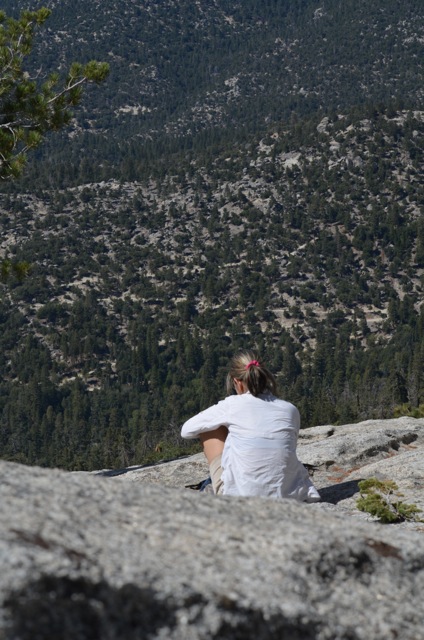
Looking down from a trail close to Idyllwild. Patterns can be seen better in the distance (geographical or time).

Looking down from a trail close to Idyllwild. Patterns can be seen better in the distance (geographical or time).

…and embraced it instead.

Some time last summer a directive came down from the powers to be, that each faculty member should submit every month a list of activities or achievements outside the planned or required activities. A collective groan was the response, and explanations were provided promptly that the lists would be aggregated and the highlights were to become “bragging points” for each school. Lists had to be bullet-pointed and divided into the three academic areas: teaching, research, and service.

After a month or so of last minute scrambling, I started a Google document and every time I did something outside my official plan (sending a letter of support for an initiative, meeting and networking, getting a presentation approved, joining a society, giving extra support for a disabled student, etc) I typed it into the document right away. I put a reminder into my calendar about sending it in time, and soon it faded away to become one more routine action of the month.

February is merit request letter submission time. As I sent this morning the December list, I scrolled up the document all the way back to June and realized that all needed for the letter was there! The list not only reflected specific actions and achievements, but also recorded the process- one month I was applying for something (which meant I spent some time writing in frenzy) and a few months later I had it accepted. Monthly small connections, meetings, and events came together as a sustained outreach effort. By recording every little thing month after month, I was able to have not only all the facts, but also see the pattern of my activity over longer periods in time.

What else to say? Lists are good. Bragging lists are useful. Admins sometimes come with pretty good ideas. Google documents rock.

The Post-It approach

1 Comment

2015-01-05 06.51.51

My morning desk with last night’s Post-its.

Another of my goals this time is to blog more continuously. Yesterday I followed a Twitter chat tagged #blogchat and the resounding advice I got was that the more you blog the easier it gets (as everything in life). And a bit like mentioned in my previous post, there are days for deep reflections and there are days for quickies. And today is a quickie day.

The first job I held after my postdoc was with a small biotech company in San Diego. The culture shock took place at many levels, but what affected me most from a practical point of view was the limitation of time to work. There was no way to do labwork during the weekends, and lab data had to be stored and processed in the company computers as well as input in a traditional countersigned lab notebook. Even evening work was discouraged!

At one level that was quite liberating- I could not work from home, so I actually worked Monday to Friday only. On the other hand, I had to be very organized and very efficient- if I blew my early week experiment that was it: a whole week was lost.

Enter the Post-it method.

Fridays became the “scrapbooking day,” e.g. the day when we would work on the lab notebook, analyzing the data, and then printing, cutting out, and glueing the graphs for the coming week’s dreaded lab meeting. That was also the day of preparation for next week’s experiments. I prepared all reagents that I could make in advance, and made detailed lists of fresh reagents I had to make on the spot. I actually calculated the exact volumes or weights I had to use, step by step.

Before leaving on Friday afternoon, I made a set of Post-its with the first tasks for Monday morning. Again, it was quite detailed: put the trypsin in the incubator, take 400 ul of the XYZ stock and add to 600 ul of whatever, turn on the instrument.

Silly as it might have seemed on a Friday afternoon, they were life-savers on Monday mornings after the hiatus of a complete weekend.

I still use Post-its a lot. In the evening, or whenever I am finished for the day with my tasks, I prepare my set of Post-its with specific directions on what to do next morning. It saves me the time of thinking through the tasks.

Do you have any other little tricks that help your productivity? Please share in the comments!

Academic skills- a moving target

Leave a comment

This blog post is related to my previous reflection on “getting things done” and prioritizing. It refers to my experience in a primarily teaching private comprehensive university.

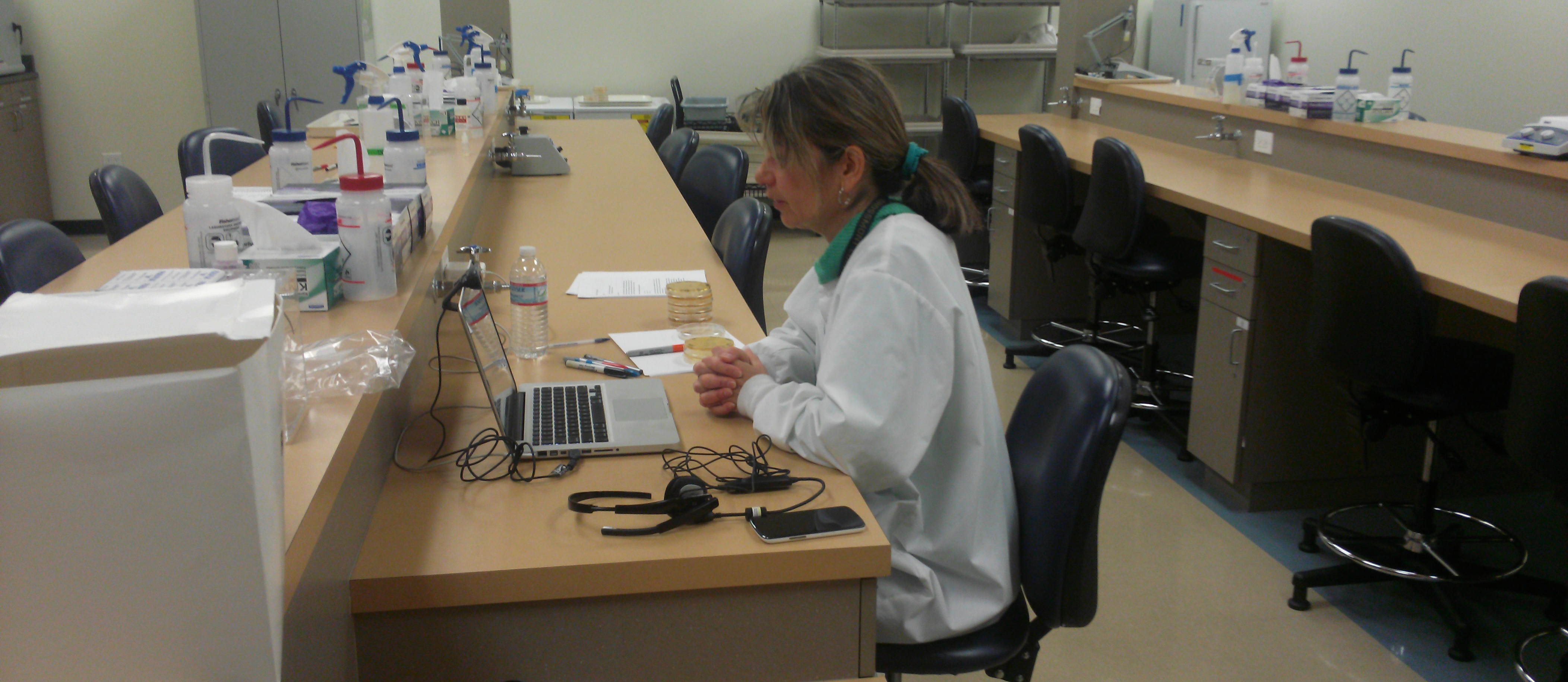
Skyping with middle schools about genetics. Very cool experience- also a bit of stretch on my abilities.

Skyping with middle school kids about genetics. Very cool experience- also a bit of stretch on my abilities.

As I look back and reflect on the many things that I had to learn just to keep afloat, a predominant group of my students come to mind.

Since I started teaching in the US in 2005, a large proportion of my students have been pre-nursing students. Over the years, I have talked to many of them about their plans and goals, and kept track of their journeys either personally or through social networking.

I feel for many of them. Expectations for nursing have shifted dramatically over the past years, from the Gold Rush of the nursing shortage in California to the recent reports of hiring bottlenecks and the sad plight of many new grads. Along the way, requirements and pre-requisites changed, making the goal a moving target. Whatever was an extra skill last year may have become required this year, and students had to adapt and scramble along the way.

It is expected, of course, especially in very technical fields, that the skills that were competitive before quickly become obsolete, and people has to keep acquiring new skills and competencies just to keep up. But it seems to me that the skill set required for a science educator has broadened considerably in just a few years.

Consider online teaching. The first time I taught an online course was in 2007, without really knowing how to teach online. Over the next years I learned quite a bit, and currently consider myself knowledgeable. During this time, being familiar with online platforms has transitioned from being slightly suspicious to something useful, and these days it is almost required.

What about education of science per se? It feels like a revolution has taken place in just a few years in how science is supposed to be taught. It is great and exciting and empowering…but it takes a while to learn about learning theories and assessment modalities. And Bloom’s taxonomy.

To boot add all the outreach and marketing skills. In my previous posting I referred to exciting side projects that fizzled- most of those were outreach projects, trying to establish partnerships and collaborations. Outreach takes time, effort, and skills. Oh and personality. As an introvert, reaching out to strangers drains me mentally and emotionally.  But even writing emails and coordinating conference calls take time and effort.

Now to the bright side. Personally, I have always been more the “Jack of all trades” kind, so most of the time I like learning new things. And looking back, it have been mainly those leaps of faith and new adventures that guided me to the next door opening, the next mentor, the next opportunity.

There is a lot lately out there about the alt-ac careers, the many “soft skills” that academics need to learn to succeed in other areas. But even in academia, there is a lot of pressure to acquire new skills besides the traditional research/writing knowledge. And it is a fine balance. Although my position is mainly a teaching position, I do lab research and hope to go back to publish hard science some time soon. How much more I gain in my teaching practice by learning a new approach if it eats into my precious time to run certain experiments? How much I gain by trying to network for a collaboration if it will affect my class prep time?

I do not do New Year’s resolutions…but some time last December I decided to really focus on a few priorities (research and publishing on the top) and try to 1) avoid the siren song of new and cool ideas, and 2) say “NO” more often. On the last day of a mostly nice holiday break (not counting a really bad bout of the flu) I am bracing myself for the return of insanity starting tomorrow. But I hope to stand firm. I will try, at least!

How to get things done, one list item at a time

2 Comments

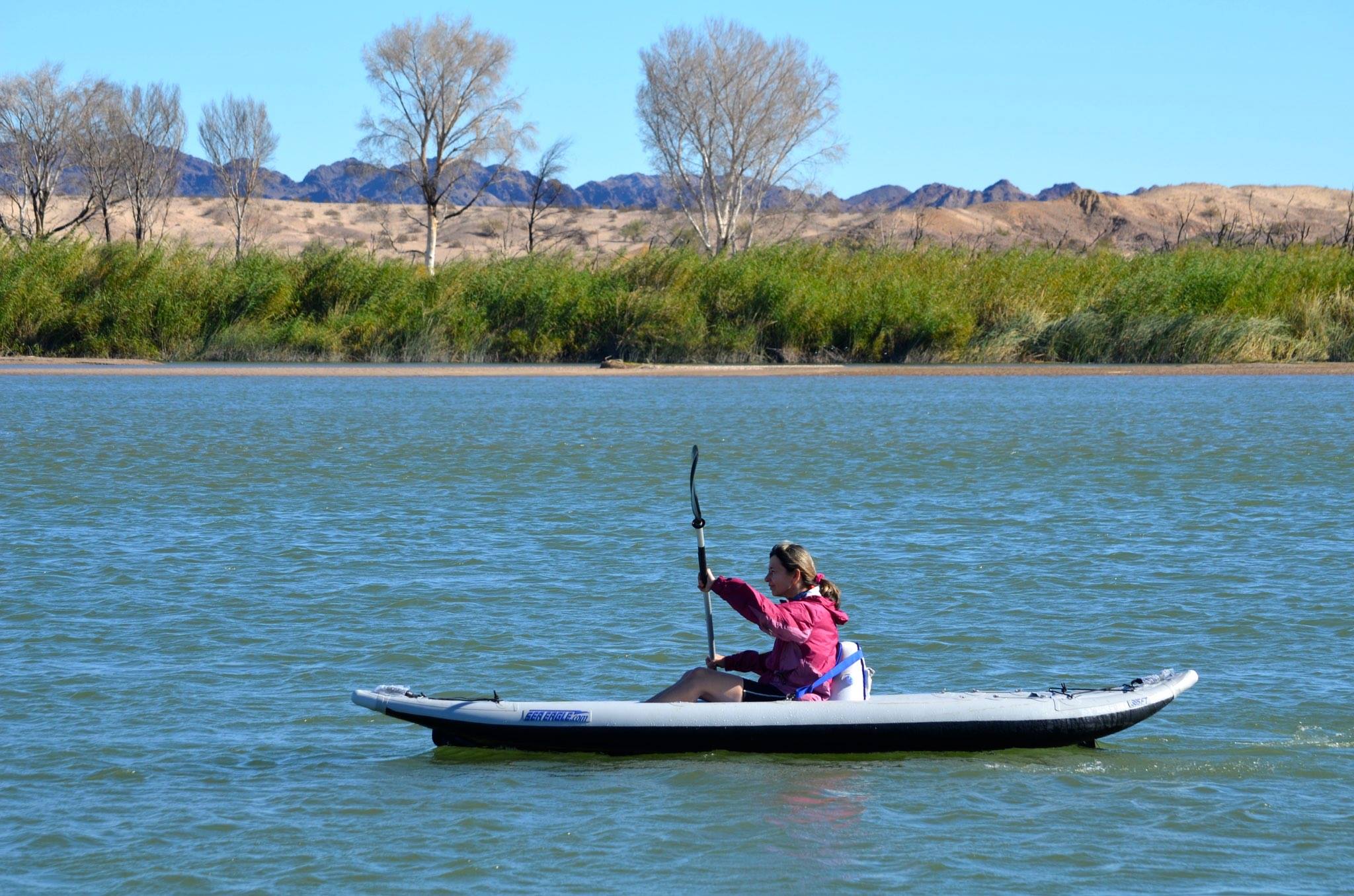
Here I am calculating the current of the Colorado River before kayaking.

Here I am calculating the current of the Colorado River before kayaking.

Since 2011 I made it a tradition to put together a “Book of the year” of pictures in iPhoto and have it printed as a family present. As I sat before Christmas selecting this year’s pictures it was obvious that they only showed a minor part of 2014: pictures of travels and visits, moving, the new cat…all nice and colorful, but the crazy grind of work and conferences and trips was missing. Which is a good thing. 2014 was a good year, but it was also an overwhelming, saturated, super busy year.

Some time in October I had an epiphany (mind you, this is not the first time). I realized  that I had neglected once more the “important” stuff such as my own research and writing in order to support a number of cool and potentially exciting initiatives. The majority of those plans fizzled, and there I was again, looking at unfulfilled timelines and datasets waiting to be tackled. Not to mention two interesting MOOCs I was taking, a business trip to Europe, and being thrown in two academic committees.  I was overloaded with meetings and conference calls. It was too much.

Fast forward to today, January 1st 2015. While craziness will resume next Monday, I have already set up the two online courses I will be teaching next, got started working on the February AAAS poster, have advanced on my manuscript, caught up with correspondence, and have finally found myself in that state of mind where most of the mental clutter has been cleared out so I am getting creative thoughts. Such a joy!

The secret was 1) having a deadline, 2) task lists, and 3) always completing something, even if a small chunk. I knew I had to be done with a number of things before Christmas because we were leaving town to go camping (= no internet, no work possibility). I made lists and I forced myself to work on those lists day after day, evening after evening. Chunking helped both in the practical and emotional sense. “Working on the AAAS poster” sounds intimidating. Looking up the instructions, deciding on a template, putting in the title and authors’ names, adding a background and saving it as a draft is necessary, took me less than one hour, and gave me a sense of fulfillment. Just like the days when I was writing my Ph.D. thesis, there were days to write the Discussion, and days to write Materials and Methods, but one had to write every day.

paddling the river

The current was strong, and it was also windy. I had to paddle steadily until I got to move upstream. Pretty much like work…

I got lots done before leaving for a short trip to the Colorado River for camping and kayaking. It was great and exhilarating, and it wiped out most of my work-related thoughts. Home again, as I return slowly to my list, it is my intention to keep the same discipline, and get things done slowly and steadily, one item at a time. Maybe 2015 will be less stressful…fingers crossed!

Assessing educational innovation: learning the hard way

Leave a comment

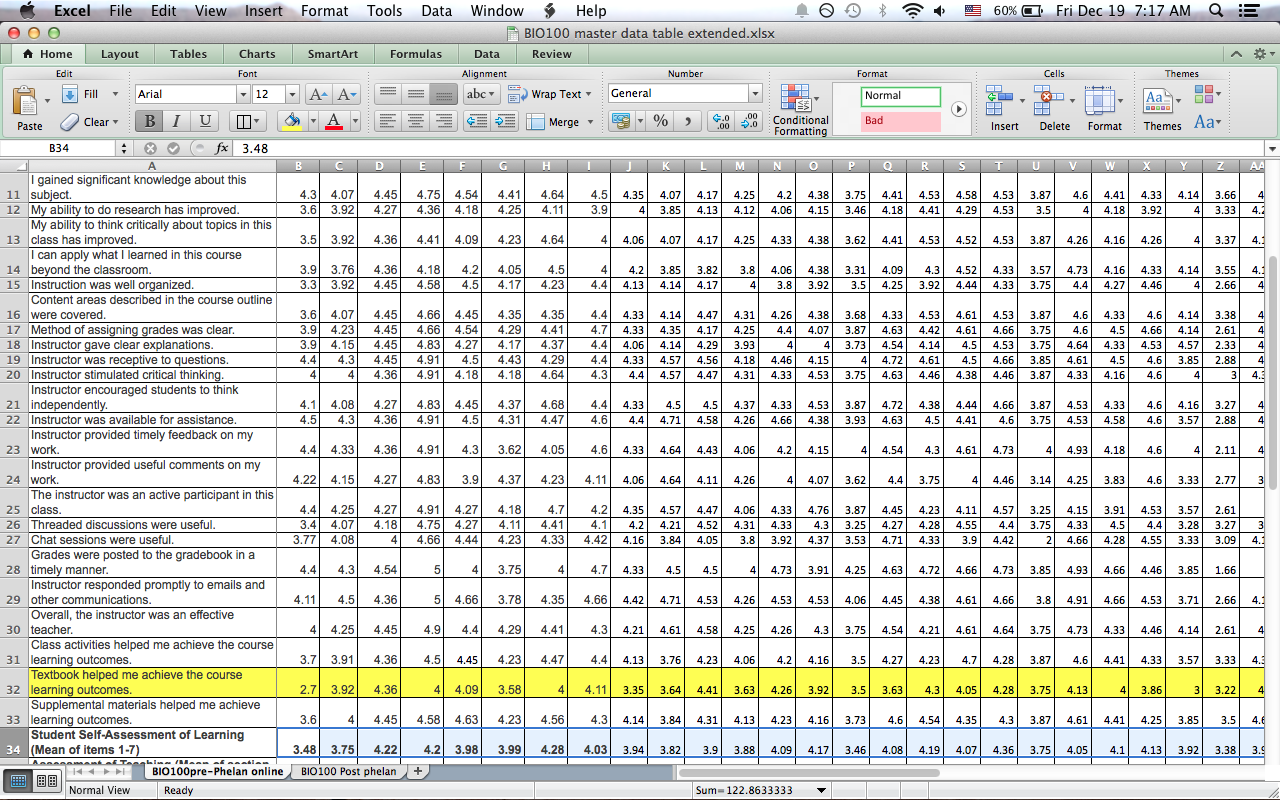
Screen Shot 2014-12-19 at 7.17.31 AM

My master data table

One of the first tasks I was given when I started in my current position in July 2012 was to be the lead faculty for a non-majors introductory biology course. That course is one of the workhorses of the university as it is part of the GE curriculum, and it is basically the one and only science class most non-science majors will take. Run in several sections in multiple campuses and online, it was a formidable task to tackle. When I took over, the course had been in place with the same textbook for many years, and especially in the online version, plagiarism was rampant.

Over the next months I explored options for a new textbook, mainly looking for something fresh and attractive, with plenty of ready-made supplementary material, low(er) cost, and options to customize. I wanted something that was “ready-made” enough for a new adjunct to tackle, but flexible enough for an experienced instructor to make changes. An instructional designer helped me to develop a nice sequence of activities and assessments that would go hand in hand guiding the students. Weekly quick surveys were added to pick up any early student issues. I asked instructor feedback, and in August 2013 we switched. I expected to see a positive change right away.

Chuckle.

My university’s accelerated schedule means that we run the course monthly in multiple sections. So there was no real time off to test drive the system. The first months were full of glitches and student  frustration. Some instructors kept their old exams with the new textbook, resulting in vociferous protests for lack of matching between material read and material evaluated. Things calmed down over the next months and currently the course runs quite smoothly.

A few months ago I decided to use the large amount of data generated to compare before and after. I had student end-of-course survey and GPA data easily accessible, as well as a number of assessment data with the new course and tons of (anonymous) student comments.

What I learned:

  1. Student survey data don’t mean anything. This is not new of course, but it did hit me with full force going over the numbers of 40 something courses. Response rate was usually around 50% in the best case. The few cases that it was higher it was usually due to issues with the instructor.
  2. With the above I mean not only that there was no difference in student perception, but that the data were not really robust. If the same instructor who has been teaching the same class forever gets really different evaluations in back to back courses, chances are there are confounders. One can be different student population. Other may be just sampling bias (who answers the surveys?) A colleague with biostatistics experience is lending me a helping hand as we speak.
  3. The hardest lesson of course, was not keeping some of the previous assessment questions in place to compare. However, I do not really know it would have been feasible. The written assignments were so plagiarized that they could be found online. The exams were straight multiple choice questions. In any case, for a flipped classroom project I am participating now I had the precaution of designing a few strategic critical thinking questions placed in the “unflipped” class serving as control.
  4. Not all is lost of course. As I learn more about how to analyze education experiments, I have been given some ideas, such as rank the students and compare their grade in the biology class and then the grade in a subsequent lab class. Maybe the approach does not help high achieving students (who will do well no matter what), but there may be some difference in the low achieving group.

Of course even negative results are results, but it would be nice to see “something” improving. The only factor that moved significantly in the positive direction was the students’ opinion about the textbook. Will see how the next round if data crunching goes…

Dear readers, do you have any insight/advice about measuring learning effectiveness? Please share in the comments…any help is much appreciated.

Older Entries Newer Entries

about flexible, distance and online learning (FDOL)

FDOL, an open course using COOL FISh

WordPress VIP - The leading enterprise content platform

This multisite hosts public sites for Parse.ly and WordPress VIP

#Microjc

An Online Summer Book Club of Science

barralopolis

Teaching and learning reflections around science education

Disrupted Physician

The Physician Wellness Movement and Illegitimate Authority: The Need for Revolt and Reconstruction

The Blog of Author Tim Ferriss

Tim Ferriss is the author of five #1 New York Times bestsellers and host of The Tim Ferriss Show podcast.

Here is Havana

A blog written by the gringa next door

Storyshucker

A blog full of humorous and poignant observations.

Jung's Biology Blog

Teaching biology; bioinformatics; PSMs; academia, openteaching, openlearning

blogruedadelavida

Reflexiones sobre asuntos variados, desde criminologia hasta artes ocultas.

Humanitarian Cafe

Think Outside the Box

Small Pond Science

Research, teaching, and mentorship in the sciences

Small Things Considered

Teaching and learning reflections around science education

1 Year and a 100 Books

No two people read the same book