The Art of Changing the Brain: Ch.1. The Sweet Edge

Leave a comment

Image

“If you stand right fronting and face to face with a fact, you will see the sun glimmer on both its surfaces…”

I love books with quotes, and the fact that this book has one for each chapter makes me like it a lot before even starting to read it in earnest. Chapter 1, The Sweet Edge, has a quote from Henry David Thoreau: “If you stand right fronting and face to face with a fact, you will see the glimmer on both its surfaces, as if it were a scimitar, and you will feel its sweet edge dividing you through your heart and marrow. Be it life or death, we crave only reality.” This is from Walden, a classic I confess I have not been able to finish reading yet. But Thoreau is one of my heroes, and this particular quote is part of a longer passage where he says: “Let us settle ourselves, and work and wedge our feet downward through the mud and slush of opinion, and prejudice, and tradition, and delusion, and appearance … till we come to a hard bottom and rocks in place, which we can call reality, and say, This is, and no mistake…” Indeed, this first chapter of Zull’s book establishes where is he coming from: a scientist who became involved with education, and decided to explore learning from a physical perspective, the science of the brain. And as a scientist, he started from his field of expertise (cell signaling in neuroscience), and went on “prying” open new doors. As he advanced in his exploration, he tried to find a practical application of each finding to teaching. And he states: “Teaching is the art of changing the brain.” Not by controlling it, but by “creating conditions that lead to change in the learner’s brain.”

He goes on elaborating on the physical nature of learning, which is based on a physical nature of meaning. He touches on the physical metaphors of learning, such as the student being a blank slate, or learners constructing their understanding. Thus, the need for metaphors in the future of teaching, which can be framed as tools for changing the brain.

One section is dedicated to the inevitable conclusion that placing the workings of the mind on a solid physical foundation is equivalent to a philosophy. He refers to the book Philosophy in the Flesh by Lakoff and Johnson, and their statement: “The mind is inherently embodied. Thought is mostly conscious. Abstract concepts are largely metaphorical.

Personally, I thought that little section was masterfully written. I mean, the phrase, “these claims have not pleased all the philosophers of the world,” is a vast understatement. Lots of people, philosophers or not, do not believe that our mind’s workings are physical. However, in a few paragraphs, Zull states his philosophy, arguments for it, mentions that it may be a controversial view, and then moves on quickly to the description of the structure of the book. Part I is dedicated to the foundations for learning, basically the structures and wirings of the brain; Part II is dedicated to how teachers can use the existing networks of the brain to enhance learning, and Part III connects the regions of the cerebral cortex to different aspects of learning, plus an Appendix called enrichments.

As I finished reading the chapter, I noticed a note regarding genes that I have missed before. It goes with the statement of the physical nature of the brain, and adds that we can even go as far as saying that our brains come from the information coded in our genes (which is a result of the structure of DNA). Considering the recent results of how the environment is able to alter the way the information coded in the DNA is actually expressed, that adds an extra layer of complexity to the statement that learning is changing the brain.

The beginning of the chapter touches on the feelings of many educators that teaching is a mysterious process, and can sometimes be almost a religious experience. And the final paragraph states: “I do not deny the mystery. I only want to solve it.

Next chapter, the second, deals with the natural relationship between brain structure and learning. Until then!

Reading project: The Art of Changing the Brain. Introduction

Leave a comment

My next reading project

This week I finally decided that I had to sit down and write a paper. For the past years, I transitioned from science to science education, and while I still have my little pet projects involving little cells in the lab, the truth is that most of my time is spent teaching. And education is a different beast, where there are learning theories and approaches and assessments and complex ideas (of which I do not know a lot about). I happen to reside in a small campus where most of the faculty are Ed faculty, and by osmosis I have learned a lot about the science of education, together with a list of readings.

So my plan is (hope it will work,) is to share the progress of reading. I am starting with a classic, The Art of Changing the Brain by James E. Zull.

“Life is learning, life is teaching.”

Ok so James Zull is a biologist, something that he will say again and again: his purpose is to discuss how the knowledge of the brain can influence teaching.

In the Introduction, Zull starts saying how his book is intended to fill a gap: to interpret neuroscience from an education perspective. Then he clarifies that he does not want to discard existing practices acquired through cognitive science or education research. But he hopes to make us understand that real learning takes place in the brain and the body of the learner.

Then he discusses some challenges about the book in general: for example, his reluctance to define learning (except maybe that learning is change). And his refusal to be classified according to a learning theory (constructivist etc). He states that he goes where biology takes him, and prefers to be “sloppy” when talking “brain science” instead of neuroscience, cognitive science etc: “definitions may imply divisions and differences that don’t really exist.”

And that’s it for today: next installment is about The Sweet Edge. Stay tuned!

Cal State may turn to virtual labs | Inside Higher Ed

Leave a comment

http://www.insidehighered.com/news/2013/05/23/cal-state-may-turn-virtual-labs

DIY Practicum

Leave a comment

Image

Glomerulus in the kidney.

The first time it was awkward. “Are we making the questions?” The students were not really sure what was the point of them creating the questions for a mock-practicum in the anatomy and physiology course. They got there eventually- and along the way they learned also about questions and questions- how hard it was to answer questions about minutia, and how important the wording of the questions were. I assigned them topics, so each student was responsible for their set of questions. They loosened up eventually, snapped pictures of the slides and the dissected sheep brain, laughed at how hard some of their own questions were, and if they paid attention, they did good at the real final. For the second time, they were ready and I heard some say “cool!” This time it was more sophisticated- they had hearts and kidneys and open fetal pigs, and they had to set up the microscopes with slides, and devise questions to go with them. The group moved around, they were checking their books, talking to each other, and sometimes even asking me questions. They may not know it, but I have such an admiration for this small group of women mastering not only the content of biology, but also its dynamics and its inner beauty. 

After less than one hour, we had the practice stations set up. Dissected specimens had pins attached and labeled, slides were taped to microscopes, and each student had developed a set of questions for their assigned topic. Some went overboard, others made simpler questions, but they were all engaged, comparing notes, discussing the results, communicating. Thinking. Creating. 

Yes, it is hard sometimes to be an educator. But there is this moment, when a student’s unfocused gaze suddenly sparks, and he or she says, OH, I got it now…and one can almost hear the wheels turning in their brains and the synapses firing. And THAT is priceless.

I have found that there are many occasions in the classroom when one can flip the instruction and empower students. The logistics is simple, just chunk the material or the task, and give it to individuals or small groups. Give them time to think and discuss. Be there for hints and clarification. Provide ample positive feedback. They may be suspicious in the beginning, but eventually they will embrace it. And at the end, this is the time when they come to life during class. They even forget that I am there.

And that is the sweetest thing of all!

My scary shirt and the invisible gorilla

Leave a comment

Image

My scary tee.

“Your shirt yesterday was scary,” says Armando (not his name). “I am glad you brought a different one today.” It is a Sunday afternoon in one of California’s many State Prisons. We, a team composed by two outsiders and five inmates, have just finished a Basic Alternatives to Violence workshop in Spanish, and are going through the required post-workshop processing. The workshop went well, everybody is happy and relaxed. “What do you mean scary?” I ask. The day before I wore a black long-sleeved tee with pink girly motives, bought at a winter resort sale years ago. I needed a warm but not too thick something for skiing, and since it had become a comfy informal attire. “It had brass knuckles on it,” Armando says. “And razorblades.” The other guys nod in agreement. I frown, trying to visualize my tee. Cherries, a little bird, and high-heeled shoes come to my mind. Brass knuckles? “Oh, come on! Those are bear paws!” I remember finally. Armando shakes his head. “Those are brass knuckles,” he says with an authority I do not dare to dispute. He must know much better than I do. While this group of men has long ago renounced their violent past and seek for ways to rehabilitate themselves, there is no denial that their 25 to life sentence was for a reason.

I do not really know what a brass knuckle looks like. I google the image, and then compare it with the supposed bear paw on my shirt. They look identical. For the first time since I bought it, I start actually looking at the motives. Cherries, a high-heeled shoe, a bird. A razor. A razor blade. Brass knuckles. A cold, uncomfortable feeling settles in my stomach.

Image

Brass knuckle

I bought the tee because of its fabric and its fit. I looked briefly at its decorations, and saw what I wanted to see- a silly collection of girly fluff: cherries, little birds, shoes. The image of brass knuckles was not familiar to me, so my mind substituted it with the nearest similar image- bear paws.

After this experience, I had searched a bit further and have discovered many websites featuring merchandise with brass knuckles on them, including women’s t-shirts.

While going to a State Prison may not seem similar to enter a classroom, there are indeed many similarities, and one involves to consider what we wear. There have been many discussions about what is preferred in a classroom: a serious formal attire or a relaxed, modern outfit. The former is sometimes appreciated by students and can elicit respect for the educator; but may be also seen as stiff and distant. The latter may help to establish a more open classroom community, but some formal students may see a jeans and sneakers-clad instructor as too lightweight. At prison, besides the rules (no blue, orange, or khaki, no jeans) it is important to avoid clothing with messages on them that may be disturbing or proselytizing, and similar care has to be taken in the classroom.

I was not aware of the menacing meaning of my supposedly harmless piece of clothing.   It was sold by a well-known apparel company, as part of a very ordinary-looking selection of winter shirts.

This is the end of my story- my shirt has been relegated now to the pile of exercise clothes, and I will be looking much more closely at any other piece of clothing with small decorations on it. Semiotics experts may discuss the importance of symbols. Other disciplines may analyze how the human brain interprets information (see the famous gorilla video or the more recent gorilla in the radiology image study).

But it still bothers me.

If you wish to know more about the organization I volunteer for, Alternatives to Violence project in California, please visit the website avpcalifornia.org.

Ha! Games for science.

Leave a comment

Ha! Games for science.

In my previous post, I was musing about games in science. I mentioned I had been away from the net for s couple of weeks, and I had not seen this article of The Scientist. Well I am glad I am on the right track 🙂

Plants, zombies, and science

1 Comment

no comments…

I recently returned from a 2 week trip to Cuba, mainly dedicated to visit family. Brought back loads of pictures and many impressions and ideas. I was disconnected from the internet world for the duration, except three brief checks of my email and two status updates on Facebook.  As both DH and myself are news junkies, I expected serious withdrawal symptoms, but we adapted quickly to a blissful state of ignorance about issues such as the fiscal cliff. I have not been as relaxed in a long time.

Back to the real world, I conducted a phone conversation about joining the bioinformatics research program I mentioned in my previous entry. The conversation, one day after my arrival, stretched the abilities of my brain cells to almost a breaking point, but I am happy to report that I am on the list for their next workshop. Sluggishly, my mind has started to remember all the great insights I had during the ASCB conference. And emails from colleagues sharing articles and insights about science education are nudging the process along.

Enter Plants versus zombies (PvZ).

During my Gamification MOOC experience, we were directed to explore Plants versus zombies as a well-designed game with elements guaranteeing success (levels of increasing complexity, enough challenge to keep it interesting but not so hard to provoke frustration and defeat, funky badges etc). I scoffed at the idea of actually trying the game- I looked at the screenshots, read the lecture notes, and moved forward.

Then came the trip and the tablet. I decided not to bring along the Apple of my eyes, my sleek MacBook Pro, and invested in an Asus Nexus 7 tablet to cover the basics (I love it, btw). I loaded it with ebooks and music, and as I had a 14 year old nephew to meet, I asked my son to put some games on it. That’s how PvZ made it into my life.

During the first leg of the travel, my son showed me how to play the game. Within hours, I was hooked. During the coming days, I, previously so condescending of the million of Angry Bird addicts of the world, spent hours strategizing about the kind of mushroom or pea shooter to choose.  And in-between, I could see why this game was used in the gamification course as an example of a well-designed game.

My nephew already had it on his cell phone, by the way.

Back to my world of science education, I keep asking myself: how to make science courses, in particular those introductory biology courses that most instructors fear, in such a way that students would find as absorbing and challenging as a game like PvZ? Is it possible to make it so interesting but without trivializing it completely?

If anybody knows the answer, please let me know.

I got a boss to fight. Be back soon…

ASCB 2012: perspective from the education side part 3

1 Comment

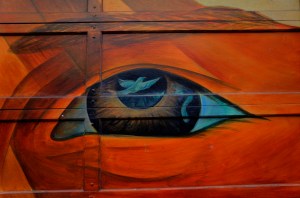
painting showing an eye

Eye from one of San Francisco’s Balmy Alley murals in the Mission district. 

Still reporting from the session called “Integrated Research and Teaching and Its Benefits to Faculty and Students.” One of the talks that energized me was “The Genomics Education Partnership: An undergraduate team research experience. ” Presented by Mike Wolyniak,  who started with a cheerful comment about how his school does not have the resources of Princeton or Stanford, it shows the possibilites of collaborative research using bioinformatics. Spearheaded by the Biology Dept and Genome Center of Washington University in St. Louis, GEP enables students from a vast array of schools including big name universities, state schools, small liberal colleges, and community colleges to collaborate on large annotation projects. At a course scale, the project enables students to get acquainted with bioinformatics tools and analysis; but taken together it weaves a huge amount of data together, which are in fact publishable. The GEP website is absolutely amazing with all its resources and documents, a goldmine to anybody wishing to learn more about bioinformatics, and open to interested faculty who wish to join the project. Needless to say, I jumped on the opportunity and hope to be able to participate next year. Great timing, as I have been eager to learn more of bioinformatics.

Later that afternoon I went to the Exhibit Hall to help setting up the poster. Poster-boards stood between the rows of exhibitors, and the section dedicated to education happened to be just by some of the major microscopy companies- in fact some of the most sophisticated varieties, as we had a couple of EM companies and customizable high-end microscopes on one side, and at the end a huge mobile expo of Beckton-Dickinson’s flow cytometers. As a former microscopy person, I was all ooh and aah over some of the toys exhibited. As an educator I could not help but be saddened by how little of this is known by students. I approached some of the big boys (those who do make microscopes for classrooms) and asked about anything for education, but they shook their heads- for this conference they brought only their high end stuff.

So it was such a contrast when I saw two posters, placed coincidentally side by side, of two ways to bring microscopes to every classroom or even to every student. The poster titled: From lab to classroom: Science  with mobile phone microscopes was also featured in an article in the Conference Pressbook. It made me smile as I have seen (and encouraged) my students taking pictures through the microscope using their cell phones- a possible feat, although requiring some adjustments. This innovation, on the other hand, makes the cellphone an actual little microscope.

The poster besides it presented the epitome of elegance and simplicity – especially in contrast to the neighboring behemoths. Manu Prakash’s Foldscope is (quoting from a TED blog): “a completely functional microscope built completely by folding paper. It offers 3 optical stages, illluminating, mask holding, and it works with the standard stains and slides so it’s universal.” The Prakash lab website does not provide much information, and he stated that he did not want the poster to be photographed, as he was still in process of having the results published. I did see the Foldscope, and like everybody else, I was blown away. It is, indeed, a paper microscope, foldable, with a slot for the slide. It can also be used open, with external light, so the image gets projected on a white surface. Moving it closer or further to the surface changes the magnification. It can be adapted also for fluorescence microscopy as judged by the poster pictures. Diagnosis of diseases (mainly those caused by parasites) and education seem to be the main potential uses of this admirable invention.

I thanked Dr. Prakash for working on this kind of innovations. I love the research statements on his lab website at Stanford, especially the one dedicated to Frugal Science.

I feel encouraged by these kind of innovations, technologies that bring knowledge and possibilities within reach of every individual. I hope that within a short time, kids in the Third World will not be only hacking tablets, but also observing bugs and plants under small portable microscopes.

ASCB 2012: perspective from the education side part 2

Leave a comment

a picture showing an abacus

An abacus- as relevant to today’s math as some of the classical genetics experiments to bioinformatics

My itinerary of the ASCB conference was guided by the Education string, which spread across Sunday and Monday. There were talks and symposia for K-12, undergrad, and graduate education. The main poster session was on Monday.

By the way- the website for the Meeting is extremely well organized, with links to abstracts, program pages, videos, and other goodies.

Among the most memorable talks from an undergrad perspective was David Botstein’s “Integrated introductory science curriculum for undergraduates at Princeton.”  He started with the observation that education of biologists have become less quantitative over the past years (decades?), and many biologists lack the math and computer science background very much needed for current biological research. (The importance of physics was a recurring theme in the meeting, illustrated by the variety of high level microscopy techniques).  To address that, Princeton developed an Integrated science curriculum. Basically, it covers a variety of fundamental topics in biology, math, physics, chemistry, and computer science; which should provide undergrads with a solid foundation to embark on any scientific discipline. One of the golden nuggets I took from his talk was the “Just in time principle,” meaning only teach what is needed at the moment to avoid student confusion. He did mention how difficult was to develop the curriculum to make it so streamlined. The other was the importance to teach only “fundamental,” not “traditional” topics, and as example mentioned some of the classic molecular biology experiments from the 1950s.  And one that really hit home was the comment ‘it is crazy to teach statistics without computers.” In fact, I have taught some statistics without computers- but quickly incorporated programs as it felt, in fact, that it did not make sense to show students how statistics is done in the real world.

Now I want to make it clear that he did not deem useless to teach the history of science experiments in general, but in the case of this particular compressed curriculum.

Another beauty of this curriculum is that computer programming is taught from day 1, including Java and Mathlab. These are very useful tools, and students feel empowered; not to mention that those tools help them to find internships or even jobs.

The next presentation was from Stanford, “Beyond the cookbook: a rigorous, research-based lab course for all.” The Bio44 lab course by Tim Stearns and his team used p53 as an attractive target for student research: to identify mutant alleles of p53 in tumors and figure out what is wrong with them. The presentation started with their goal: to offer a lab course with real experiments, leading edge tools, and modern technology. The techniques used were quite impressive for a student lab: from bioinformatics to western blots including GFP tagging. And the student evaluations made the audience chuckle- some students expressed their frustration at the amount of troubleshooting and repetition that had to be done for success- something scientists are very familiar with.

A common theme of both presentations was the amount of resources and funding needed for such programs and courses. Throughout the education string of the conference it was evident that without generous funding by (among others) the Howard Hughes Institute, NSF, or the Bill and Melinda Gates Foundation, many educational innovations could not have happened.

However, there are options open to less privileged institutions….coming in part 3.

ASCB 2012: perspective from the education side part 1

2 Comments

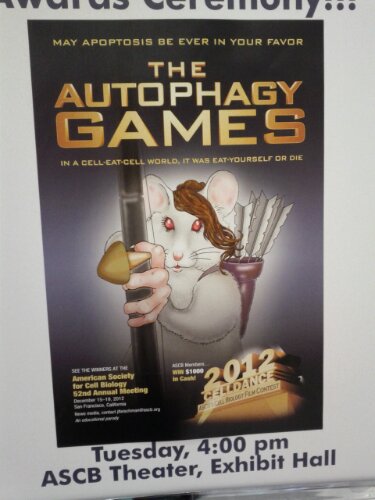
A poster imitating the Hinger Games at ASCB2012

I was reading The hunger games during the conference, so this poster made me chuckle.

I confess this is my first American Society of Cell Biology meeting, and very probably the last also. It was not my kind of meeting even when I was involved with Cell Biology research: it was just too broad, too “basic;” and more specialized meetings were preferred- cancer, immunology, etc.
My plan this year was to aim at an education conference or a science conference with a strong educational angle (ASM CUE comes to my mind)- am still hoping for it! But it just happened that one of my collaborators at Carnegie-Mellon University’s OLI project,  Anya Goodman, was presenting there, and she proposed a poster about our preliminary data. Thanks to her diligence the abstract was submitted in time, and got accepted. The meeting being in San Francisco, I was able (and happy) to attend.
As anybody attending a research conference knows, a lot of prep work and planning helps getting things done. My goals were to learn about any major cell biology paradigm changes but mainly to connect with other educators involved in science and particularly biology education. In fact, I was pleasantly surprised to see a whole education string.
Another aspect that surprised me was the openness to non-scientists. The keynote address was open to the general public (upon registration), and the speakers: Secretary of Energy Steven Chu and Apple and Genentech chairman Arthur Levinson tailored their talks to appeal to both scientists and non-scientists, a difficult feat in which the former was more successful. Chu combined overarching visions with witty humor, explanations of scientific findings with inspirational advice, and achieved a general feeling of elation of having somebody so accomplished and smart in our Administration. I just discovered his talk has been uploaded to youtube.
On the other hand, Levinson’s talk went deeper and was more technical; and while his presentation was exciting to those in the cancer field, it sounded a bit too promotional of their new product. Which is understandable. But maybe not the most appropriate for a keynote speech.
There was a whole corner dedicated to educational resources, of which I snapped up many (and they are still in my to-be-sorted pile), but what was encouraging was the number of books, pamphlets, and talks dedicated to grad students and postdocs who may be considering education as a career path. That this included mainly teaching institutions (even community colleges) is in indication of the reality check of scientific organizations.  In fact, I was very pleased to see at any of the education-related events many students, not only professors.

In the next part (parts?) I will address some of the most memorable talks/presentations I attended.

Older Entries Newer Entries

about flexible, distance and online learning (FDOL)

FDOL, an open course using COOL FISh

WordPress VIP - The leading enterprise content platform

This multisite hosts public sites for Parse.ly and WordPress VIP

#Microjc

An Online Summer Book Club of Science

barralopolis

Teaching and learning reflections around science education

Disrupted Physician

The Physician Wellness Movement and Illegitimate Authority: The Need for Revolt and Reconstruction

The Blog of Author Tim Ferriss

Tim Ferriss is the author of five #1 New York Times bestsellers and host of The Tim Ferriss Show podcast.

Here is Havana

A blog written by the gringa next door

Storyshucker

A blog full of humorous and poignant observations.

Jung's Biology Blog

Teaching biology; bioinformatics; PSMs; academia, openteaching, openlearning

blogruedadelavida

Reflexiones sobre asuntos variados, desde criminologia hasta artes ocultas.

Humanitarian Cafe

Think Outside the Box

Small Pond Science

Research, teaching, and mentorship in the sciences

Small Things Considered

Teaching and learning reflections around science education

1 Year and a 100 Books

No two people read the same book