Riding with Miss Coco

Leave a comment

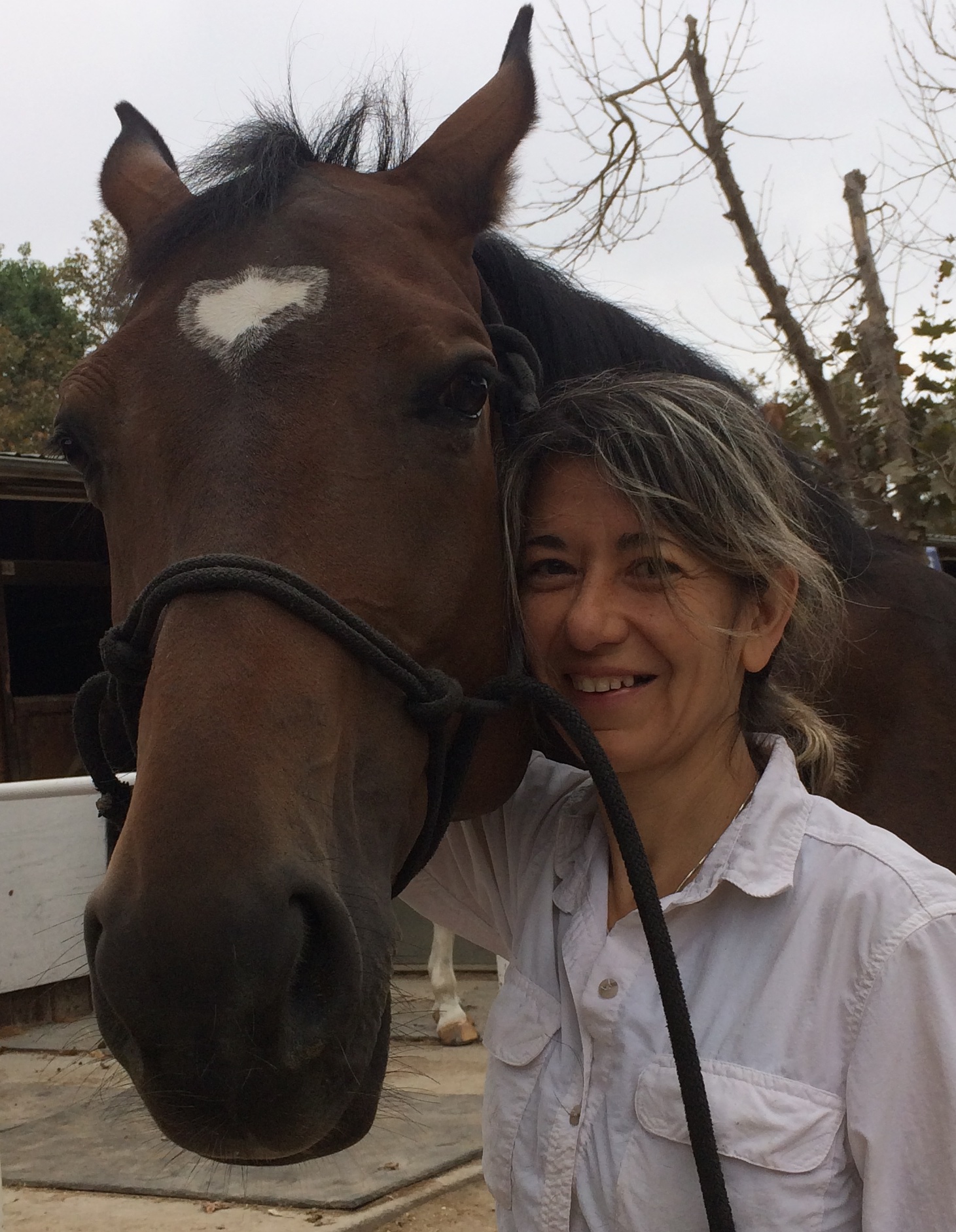
Miss Coco and I

Miss Coco and I

When I was a teen, I spent a couple of vacations horseback riding. It was in Cuba, and there was not much system to it. My brothers and I would rent horses in the morning (it was a big country park called Escaleras de Jaruco) and spend the whole day on horseback. I loved it.

Fast forward a few decades to now. In the time in-between, I may have ridden less than ten times, mainly on designated trails. So when I decided a few months ago to take advantage of a free lesson deal, I did it with trepidation. Learning English riding at my age feels borderline ridiculous. Good thing that at my age I do not really care about ridiculous anymore.

Sara the trainer is young and bubbly, and oozes positivity. During the past months (I take one class per week), she has taken me through the very basics and some bareback riding to practice leading with movement and voice only. Every time I miss a class (or a whole month as recently) she patiently walks me through the process again from square one.

All in all, I love it. I love the connection with the horse, Miss Coco. I enjoy Sara’s approach of trusting the horse and communicating with them. And of course I relish the exercise.

So what this has to do with my usual topic on education?

This morning, as I was painfully two-pointing and getting frustrated by how much I have lost for being off one month, I thought about what a silly client I must be for Sara. She trains people to become competitive riders, and here she is walking me around and tugging at my toes and knees to have them in the right position. We both know that I will never become good at this. But she is encouraging and positive. She gives me feedback and shows little tricks. As a result, I enjoy horseback riding, and want more challenges. I enjoy it even if my muscles burn and my back protests after every class.

In summary, Sara is a great teacher.

It came to me how easily we focus in class on our stellar students, the ones who do well, who want to become scientists and doctors, the ones who perform closer to our level. And how often we lose sight of those who know they will not be A students, but still may enjoy the ride, may still learn a lot and feel a deep sense of accomplishment.

From this year’s courses, I have five students who are coauthors of posters that will be presented at the AAAS conference  student competition next February. They are the typical non-traditional students: all work, and one is an active military.

I am immensely proud of them. They are extremely accomplished students who did very well in my classes.

But after this morning’s exercise, I wonder about the many others. And I promise to myself to look harder after each student. Because there is much happiness and accomplishment that can result even at a “lower” level of knowledge. And as educators, it is our goal to reach the “bliss point” of learning for each of our students.

Lost in translation: science and education research

Leave a comment

Somehow this picture of a reflection seemed appropriate for the posting. Taken close to Ballarat ghost town, west from Death Valley NP.

Somehow this picture of a reflection seemed appropriate for the posting. Taken close to Ballarat ghost town, west from Death Valley NP.

One of my favorite bloggers is the fearless @hormiga Terry McGlynn, with whom I share many challenges related to teaching science and doing research at a mainly teaching institution, serving mostly underrepresented/minority students to boot. I enjoy his no-nonsense postings and practical advice, like today’s list of advice for education faculty to approach science faculty about new teaching strategies.

As I look back to my own journey, I am trying to remember how I became interested and engaged in trying novel educational approaches. I do not really recall any education researcher approaching me about it. It all started with me needing to design an online course, for which I had to take a training. There I heard for the first time about Bloom’s and backward design. Later I took an online teaching certification, which was a great eye-opener and game-changer for me. In my group, the next closest to science was a professor of health and nutrition. For a while I felt quite alone trying to figure out how to apply those approaches to science education, until Twitter put me in contact with bigger names already doing it. In a few years, science education started to appear in Science magazine, Vision and Change popped up in the radar, and research-based courses were all in the rage (for examples see GEP, SeaPhages, Small World Initiative, Genome Solver– disclaimer, I participate in two of those). So in my experience, it have been mainly scientists who ‘converted” to the new approaches and moved from straight lecturing.

However, going back to Terry’s list, I would add one more to the list: express the challenges of education research. In contrast to lab experiments, where it is relatively easy to control for variability, “experiments” with students are studded with confounders. Student randomization is often impossible, resulting in gains without an actual intervention. How to measure student learning is still in the works (collecting references would be part of a thesis, or maybe a separate blog posting). Scientists love challenges, and one way to entice them could be to express how hard it is to design and evaluate such interventions. From my own experience, a science person tends to believe that the only thing that is needed is to compare an experimental and a control group and voila! In the optimal case then, dialogue ensues, where both the practical and the less tangible confounders are evaluated, discussed, and hopefully addressed.

Your Inner Fly: Fighting dipterans share genes with you and me

Leave a comment

This is very useful for my current Molecular Biology class. Also for anybody getting introduced to Drosophila.

whyevolutionistrue's avatarWhy Evolution Is True

Introductory note by JAC: Matthew has produced a terrific post here, and I hope people will read it. The results of this scientific analysis are amazing and the genetic tools required to produce them are breathtaking—tools I couldn’t have imagined were possible when I was a graduate student. If I had one hope for 2014, it would be that more people would read the science posts. (Maybe you do, but just don’t comment on them!) kthxbai

******

by Matthew Cobb

In 2007, the genomes of 12 closely-related Drosophila species were published in Nature. This was an important moment because it enabled researchers to look beyond their traditional friend, D. melanogaster, and to study the similarities and differences between the behaviour and genes of ‘the’ fly and those of its relatives, for some species had separated only a million or so years ago, while others were much more…

View original post 1,209 more words

Dear American Gut & uBiome: You Have Some Explaining To Do.

Leave a comment

Well now I am curious…

We all like to play with tinkertoys

Leave a comment

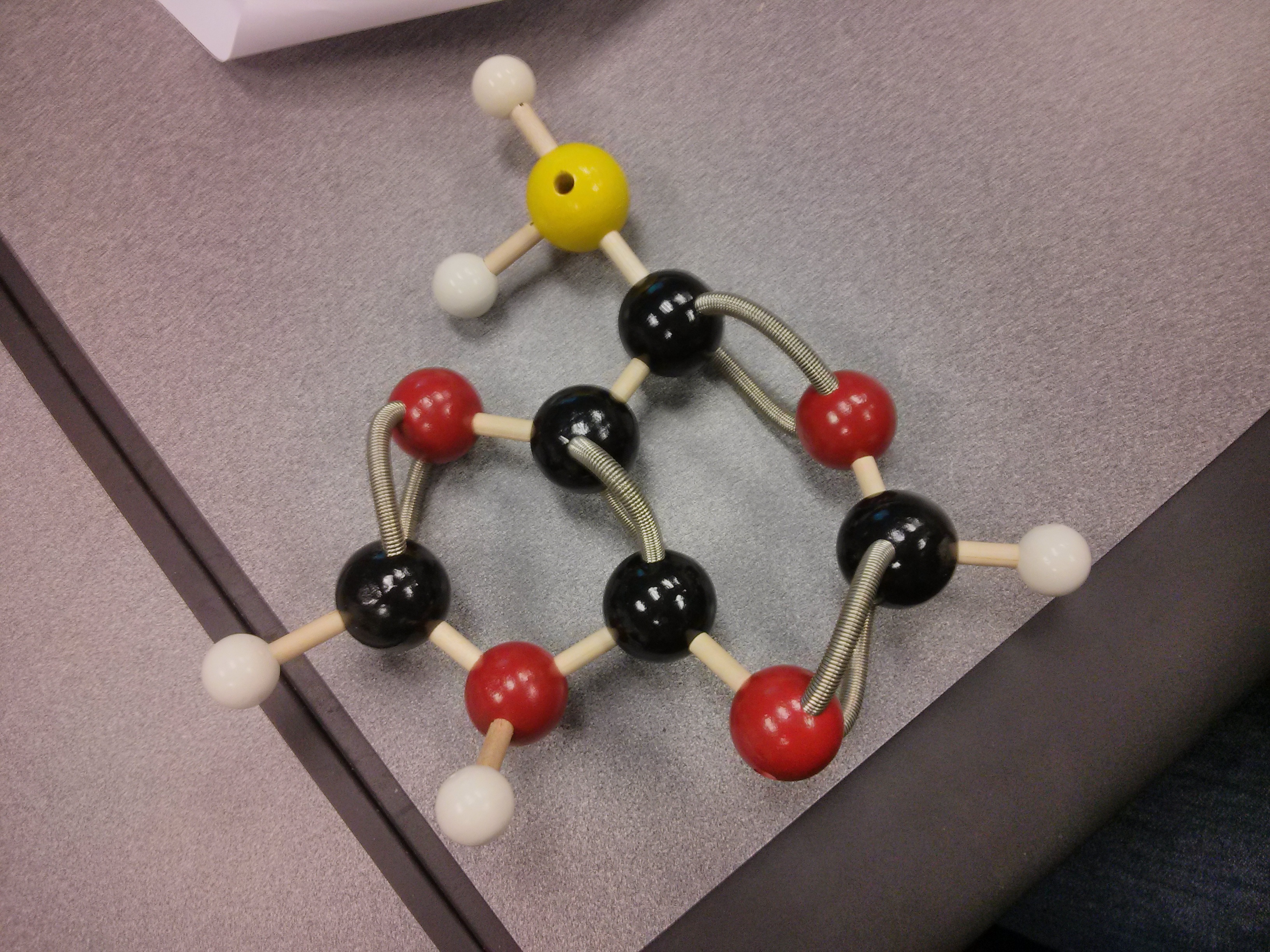
A primitive model: adenine

A primitive model: adenine

A little over a week ago the humongous *all things biology* conference called Experimental Biology took place in sunny San Diego. I was delighted to participate as a representative of the Small World Initiative with an oral presentation and a poster. It was well-received and I felt very energized by the conversations and connections. I did the usual conference stuff: attend sessions, check out the posters, let the vendors scan my badge in exchange of bags, mugs and other freebies, and of course meet friends.

However, one of the highlights of that weekend was a meeting that was associated but not part of the conference: the workshop entitled “Fostering partnerships among colleges, universities, and K-12 schools.” Organized by the Hands-on Opportunities to Promote Engagement in Science (HOPES) group, it was a morning of delightful exchange of experiences between scientists and K-12 schools. 

At the end of the session, a group from the Center of Molecular Modeling took center stage and distributed colorful bits of the molecular world to play. Scientists and teachers, young and less young alike took the pieces in their hands to try to solve the puzzles: amino acids color-coded by biochemical characteristics could be pinned to long foam rods to make polypeptides and then fold them in space; nucleotides made DNA strands, and enzymes had active centers ready to be occupied by substrates or inhibitors.  In a way, we did what students tend to do- “DO.” We were hardly listening to the explanations, as we wanted to figure out ourselves what to do with those pieces. We talked to our neighbors and put pieces together. We were like children with toys. Because, children play…and learn playing. Somehow, we forget that, students and teachers alike.

IMG_20140506_174914

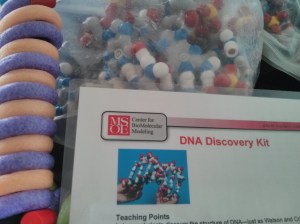
The DNA Discovery kit from MSOE Lending library has enough nucleotides to build an actual helix!

I thought immediately of the course I started teaching this week, Molecular Biology. I have studied and worked with sequences and genes for many years, but it was only when I descended into the depths of gene elements when learning bioinformatics that those strands became real for me. And many times, 2-dimensional knowledge remained hopelessly elusive until I was able to see it and touch it in 3D. I asked about the models, and it turned out they can be borrowed! Excited, I sat in a corner with my laptop and ordered the models right away. I knew they could not arrive the day of the first class, Monday, but I was restless about structures. I dug deep in the bowels of the lab and found two boxes of simple chemical models of the type to make small molecules with sticks and balls. Brought to class, they were only enough for a purine and a pyrimidine. The 2 groups of students came together and built the structures, taking more time than expected- indeed, such a stretch from the plain figures of the textbook to the spatial form! But it was…a small affair after all. Just one base pair.

But guess what waited for me today on campus! Two big suitcases, full of toys! Well, I guess we’ll play again tomorrow. We have now a whole set of tinkertoys of the molecules of life.

Mercury in retrograde and why we teach

Leave a comment

Image

Light. Happiness. Thankfulness.

Few years ago, one of my wonderful quirky acquaintances explained to me that when things seem to go awry all the time, it is all Mercury’s fault. “When Mercury is in retrograde, she said, there is not much you can do. Just try to survive, and don’t engage in important communications during that time.”

Today was one of those days. Each and every communication I had today did not go well. Nothing *bad* just…disappointing. Things that I thought had been approved and decided returned to me. Questions I asked were not answered. Or if they were answered, they sounded snappy. By mid-afternoon I felt enveloped in a dense grey cloud. Then I checked: Mercury is in retrograde February 7-28. Oh well.

What is a geek to do? She goes to the lab.

Some of my current students have fallen into a phase of ugly plates and inconclusive Gram stainings. While we want students to figure out what to do on their own, I felt intervention was necessary. I always feel queasy about too close supervision (due to my historical dislike of micromanaging), but I have also read that structure is good for students, especially those with less preparation. So yesterday I checked and troubleshooted with them, and devised some simple strategies to figure out what was going on.

So the geek goes to the lab and looks over the newly inoculated plates, and she is happy that the plates (streaked with me looking over the students’ shoulders) look great, and that the green sheen suggestive of a P.aeruginosa contamination is not there anymore. And when she opens the incubator and the smell of landfill surrounds her, she is happy that all those pesky microbes are obviously happy.

(On a side note: some years ago I visited a clinical microbiology lab. The lady in charge, one of the awesomest microbiologist I have met, at a certain corner of the lab sniffed into the air and said, with a half-smile “Don’t you like the sweet smell of Pseudomonas?” At that time it seemed a bit extreme, but not anymore. Every time I open the fridge full of soil plates I smell half-rotten fish. I am so curious which of those many colonies smell like fish and why. Yes, I am getting attached to the little buggers.)

But once out of the lab and walking toward my office, the cloud is back. I am not looking forward facing real life.

Oh my. There is a bag on my desk, labeled with my name. I “awww” to myself. It happens occasionally, especially at the end of a course. I am touched, but I do not look inside.

It is only at home, after driving through Friday afternoon traffic, that I look into the bag, searching for the card. It is a sweet thank you card from a former student. I am so moved. The grey cloud has lifted, and I am back where I should be. Thank you so much.

Those of us who teach don’t do it for the fame or the money. In fact, we don’t do it for thank you cards. We do it for the “a-ha” moments, for the light shining up in the eyes, for the times when the students get something they did not before.

But it is nice when we hear back. Another student emailed me last week: “Comparing to your classes, the XYZ test was a cake!” She got in the 99th percentile of the qualifying test for her program, and was bubbly. I had to chuckle.

Thank you, dear students. And honestly, we cannot do it without you. Thanks for joining the ride, as bumpy as it may be sometimes. Really, you make it worth.

PCR happy ending

2 Comments

2014-01-17 18.04.26

Me taking a picture of the envelope taped to the front door before leaving Friday evening. Just in case.

When I wrote the previous post about my anxiety regarding the PCR reaction of the soil cultures, I did not explain the main reason for it: this was to be part of an actual laboratory class. Those of us who teach lab classes know the feeling of slight embarrassment when things go awry. You expect a reaction that does not happen or the microbes don’t look the way they should. Reasons abound: from human mistakes and carelessness to expired reagents, bad batches, or plain biology. Sometimes it can be made a teachable moment, but not always.

So last Thursday I went to the lab hours earlier and did a mock run, which was a good idea, because I made a number of mistakes, one being walking away after pressing the Start button. Turns out the machine wanted me to press an additional OK, then asked about 2 more settings, and finally made me confirm that I was ready to run. Luckily after half an hour I had started wondering why the machine was so quiet. Duh.

By the time the students rolled in I was feeling much better, and after pipetting the reagents of the first tubes, I asked for volunteers. There were several, and as they were enthusiastically pipetting the 1 ul volumes I started wondering if that was a good idea. None of those students had ever used a micropipette before.

But they were delighted and enthusiastic, something that all participants of the Small World Initiative have reported. Ownership of a project comes hand in hand with motivation, and once the tubes were in the machine and the students returned to their plates it was a joy to watch them discussing their soil isolates.

When I ran the electrophoresis the next morning, I was a bit disappointed but not surprised. One lane had a clear band, some had faint bands, and the rest were smeary. As I expressed to one of the students the day before: we want the first experiment to work, but not perfectly so we can improve it for the next time. A first flawless experiment is almost always a fluke, and we cannot learn from it.

So I ran the samples again, this time in the blessed quiet of the lab. Things looked much better. I called the company that would do the sequencing, and scheduled a pickup around 2 pm. Put the samples in an envelope, left them at the front desk, and went on with my things. At 5 pm, the envelope was still at the front desk. Called the company, and they told me the courier was on its way. “LA traffic, you know.”

Our building closes at 6 pm, as the receptionist dutifully reminded us around 5.50 pm. The envelope had not been picked up. I was leaving town next morning, and started panicking. Three frantic phone calls later somebody picked up the phone at the company. I explained that the building would be locked in minutes, and was advised to tape the envelope to the front door. At 6.30 pm, I had to leave with a heavy heart.

Next morning I had not received any emails or calls concerning envelopes taped to the front door, so I assumed things were under control. It was in LAX 10 minutes before boarding the plane that the email rolled in: Please log in to see your sequences…

The next few minutes were almost rapturous. I logged in and discovered the majority of the sequences were “great” or “ok.” Few had issues. Knowing that students were using the long weekend to work on their poster presentations and they needed the data, I frantically copied and pasted the sequences into a document and sent them away before boarding the plane.

It was not until late in the evening that I was in internet range again. First I ran a sample I had sequenced before and used as a control. The hotel wifi was a bit sluggish, but Blast finally came back with the correct result: Pseudomonas. I almost hollered.

The sequences came out interesting- some expected genera, others less expected. It will be interesting to see how the genetic data compare with their traditional microbiology tests.

I am happy.

Nudging my Dad

Leave a comment

P1050583

Dad and I, in the very beginning.

As I write these lines, my dad is already up in Havana. He stays up late at night and gets up early, sometimes in the middle of the night if inspiration hits him. After breakfast he will sit and fire up the oldish PC and check his email through a dial-up connection. As most people in Cuba, he does not have access to internet at home, but he can send and receive emails, the main way of communication between us. Through the years I have subscribed him to newsletters, and copied and pasted big chunks of information and articles into bodies of email for him to read. In his 80s, my dad is still very curious about the world.

That is one of the reasons I subscribed him to my blog. Other reasons include an added motivation for me to write regularly. But my main hope is that he will be eventually writing his own blog and that way widen his circle.

ana papi sepia

Dad and I, last year.

My dad has many stories to tell. He wrote an autobiography some years ago where he tells about his “lives in succession” from his native Spain to Cuba. After the first book, the writer’s bug got him, and he has several books in the making related to his experience in criminal justice and history. But we kids are currently enjoying his newest work, coming in email installments, about the adventures of a globetrotting character born in the island of Lampedusa.

In the book The End of Big, Nicco Mele tells the story how his elderly father wrote a book by transcribing his letters from WW2 and publishing it as an ebook through the internet (with his kids help, of course). Besides being a fascinating read for the family, it turned out a way for the father to connect with a number of people who had similar stories and experiences, enriching his social life.

My dad taught me many of the important skills in life, from swimming to driving, from how to give IM injections to how to avoid getting drunk. He introduced me to chess, the love of philosophy, and in general the joys of intellectual pursuits. Over the years we have been close or far, depending on which corner of the globe I happened to reside. And communications have ebbed and flowed depending on the demands of life.

But as of today, I am enjoying this common interest in writing, and I do hope we will become blogging buddies in the near future. Looking forward it 🙂


The small details that make love great

1 Comment

Image

Water…

There is a saying in Spanish about “los pequeños detalles que hacen grande el amor.” The small details that make love great.

I was thinking about it today.

Nuclease-free water.

We are doing PCR Thursday as part of the soil project. First PCR reaction in our brandy new PCR machine, and then second electrophoresis run ever in our brandy new electrophoresis set. Laugh if you want. I used to do research in Cuba, using stockings at the end of chromatography columns and candle jars instead of CO2 incubators. Life is good.

I had decided to play safe. No PCR from scratch, let’s get the ready-made beads. For the first trial, we can do with ready-made buffers. Let’s not risk the experiment.

But I forgot the small detail. High quality, nuclease-free water, per the protocol.

We’ll get it by Thursday, somehow. But it is funny, at the end.

We made all those considerations about PCR, ready-made beads and the sequencing place, the ethidium bromide disposal, and the filter to take pictures with the transilluminator. But we forgot the water.

And David Foster Wallace’s commencement speech comes to my mind:

There are these two young fish swimming along and they happen to meet an older fish swimming the other way, who nods at them and says “Morning, boys. How’s the water?” And the two young fish swim on for a bit, and then eventually one of them looks over at the other and goes “What the hell is water?”

Tomorrow will be another day.

Lecture cleanup

1 Comment

Becoming superhuman?

I happened upon Tim Ferriss’ book The 4-hour body a year ago. I was desperately looking for a system that could keep me more or less fit in spite of the regular academic crunch times. I confess I do not have the discipline of finding some time for exercise no matter what. My tendency is to work on a task basis, which means taking no breaks until done. That meant hours and hours sitting in front of the computer, and it was taking a toll.

The book was fun to read, and the diet and exercise advice worked for me. I do not follow it as rigorously as before, but it is still the basis of how I eat and how I exercise. (Just to be clear: I am not endorsing it or anything, just sharing that it worked for me).

If you are not familiar with Tim Ferriss, he is a sorts of accelerated learning expert as explained in his bestsellers (the latest being The 4-hour chef). In a self-deprecating and humorous manner, he shares his ways of mastering new skills, from new languages to gourmet cooking.

I was thinking about it as I started reviewing my lecture powerpoints for my current microbiology class.

One of Tim’s main points is that most activities can be mastered in an accelerated optimized way. As my teaching takes place in an accelerated environment, most of us teaching at NU explore learning strategies supportive of this approach. Traditional lecturing is not really feasible- many of us combine short lectures with group activities, audiovisuals, or more active approaches to chunk the content and keep students’ interest.

However, as I went over my lecture slides, I started noticing things. Apologies in advance that I am going to talk now about metabolism…that was the chapter I lectured on.

For starters, there were slides that did not make sense where they were except for me. For example, after an introduction to metabolism and metabolic pathways, there was a slide about oxidation-reduction. I know that this is an opening to what is coming next, which is the topic of carbohydrate catabolism. But why talk about oxidation-reduction in abstract first, when I will have to explain it later anyway when referring to what happens during cellular respiration?

The second thing I noticed was lots of material irrelevant for the particular student audience (this case pre-allied health students). Yes, it is pretty to show the names of the components of the electron transport chain, but in all honesty, I do not remember many of them (and I was a biochem major).

Tortora chapter 5

Oxidative phosphorylation, summarized.

I started cleaning up my slides. I took away all information that seemed superfluous, and arranged the slides so there was a clear narrative from beginning to end.

Lecture was yesterday. I followed the narrative of the slides, repeating several times the basic messages. Once students got the relationship between oxidation, reduction, electrons, and hydrogens, I made them look at the metabolic pathway diagrams and count carbons, NADHs, and ATPs. I was stoked seeing their faces, deep in thought as they followed the path of energy. I asked them to turn to their neighbors and explain things with their own words. They asked questions. They were engaged. This chapter is one that I usually dread to teach, but last night was an exception.

We often say “less is more,” but it is not always easy to let go of material or approaches that seemed necessary to achieve something. How much of it is really necessary, and how much of it is tradition and inertia?

Dear educators, how do you achieve a balance between the content that one is supposed to teach and what is really relevant to teach?

Older Entries Newer Entries

about flexible, distance and online learning (FDOL)

FDOL, an open course using COOL FISh

WordPress VIP - The leading enterprise content platform

This multisite hosts public sites for Parse.ly and WordPress VIP

#Microjc

An Online Summer Book Club of Science

barralopolis

Teaching and learning reflections around science education

Disrupted Physician

The Physician Wellness Movement and Illegitimate Authority: The Need for Revolt and Reconstruction

The Blog of Author Tim Ferriss

Tim Ferriss is the author of five #1 New York Times bestsellers and host of The Tim Ferriss Show podcast.

Here is Havana

A blog written by the gringa next door

Storyshucker

A blog full of humorous and poignant observations.

Jung's Biology Blog

Teaching biology; bioinformatics; PSMs; academia, openteaching, openlearning

blogruedadelavida

Reflexiones sobre asuntos variados, desde criminologia hasta artes ocultas.

Humanitarian Cafe

Think Outside the Box

Small Pond Science

Research, teaching, and mentorship in the sciences

Small Things Considered

Teaching and learning reflections around science education

1 Year and a 100 Books

No two people read the same book