I should really take a writing class…

Leave a comment

A picture of the statue of a blue elephant on a pier.

One of the elephants of the Elephant Parade, currently in Dana Point, CA. I can identify with elephants: slow and persistent.

I have not blogged in quite a while, which is mildly frustrating. Last week was almost exclusively dedicated to my university’s Fall Assembly, which is one of the two times per year that most (if not all) faculty and admins from all campuses are physically in the same space. Needless to say, those are the days when most businesses and collaborations get done or started, so besides the programmed meetings there is a lot of networking going on. Add the couple of days before and after spent in a frenzy of prepping and then catching up with grading and everything else, and the week is gone.

But I have realized that one of the issues that affects my blogging is English writing. I feel my writing is quite ok, and my spelling is far better than that of many of my students, but my original Spanish does bleed over in a way I structure certain sentences (usually much longer than acceptable in written English). And although late nights are usually my quietest times and when I often have most inspiration, that is also the time when I tend to make more mistakes. So I often will start a posting at night with the determination of reviewing it next morning…and very often the draft stays a draft. Every time I look at my list of drafts I cringe. The only times I had been able to write more or less regularly were the times where I forced myself (like now) to sit down after breakfast, write, and publish on the spot.

The thought of taking a creative writing class in English has been in my mind for quite a while. And recently I learned the importance of good English writing in a context way more important than blogging: while assembling my reappointment dossier.

My university does not have traditional tenure, but timed appointments (starts with 2 years, and depending on the metrics and rank the length increases later on). Honestly, I find the system much more energizing than the traditional one- keeps people on their toes because even with a certain job security one has to prove one’s value on a regular basis. I see old timers working really hard and exploring new things all the time.

My appointment is until next July, but I was strongly suggested to complete my dossier for the Fall reappointment cycle so I’ll know by the end of this year. So that has been another of my reasons not to blog as much as I wanted- assembling the dossier was quite an undertaking.

Following my elders’ advice I had started collecting documents months ago, and created a google document where I would type my achievements as they happened (certificates, committees, you name it) as well as ideas for my reflections. The latter was absolutely critical at the time of the actual writing- having inspirational quotes and ideas at hand to frame my uniqueness and excellence made the job much easier.

But it was only when I read the detailed instructions and the reappointment process that it hit me. My reflections would be read not only by scientists, but by colleagues from all disciplines, including humanities. I was not asked to write a research proposal or a grant application: I was asked to do creative, elegant, and convincing writing. Now that was scary.

Of the three required reflections (teaching, scholarship, and service) I was told the hardest to write and the most scrutinized would be the teaching one. So I spent most time on it, and at the end I was quite content with the result. After many iterations of the opening sentence, I decided to just dive in to define who I am: “I came to teaching through science, after long years of working as a research scientist. Therefore the core of my teaching is the passion for science and particularly biology literacy.” After that I defined some of the main pointers in my teaching practices, and then included a quote from Steve Jobs that I have always found inspiring and very true: “That’s been one of my mantras – focus and simplicity. Simple can be harder than complex: You have to work hard to get your thinking clean to make it simple. But it’s worth it in the end because once you get there, you can move mountains.”

No kidding.

After I was done with what I considered to be a literary masterpiece, I sent it to a number of mentors, and in a spark of inspiration, to one of the English faculty asking for feedback. That was the best thing I did. He sent back the document with a number of minor corrections and comments regarding transitions and lack of clarity, and once corrected I felt much better.

On the other hand, all the time invested in the teaching reflection meant I spent much less time on the service and scholarship reflections. To be honest, I was typing the final version of the service reflection the morning of the due date. Ouch. My husband was kind enough to review and correct some of my usual grammar booboos (I still have difficulty with the usage of “X and me” versus “X and I” among others), but without the feedback of the experts I know they do not measure up to the teaching one. Fingers crossed.

After this experience, I am again seriously considering taking an English writing class. I doubt I will be able to do it any time soon, but the prospect of hopefully being able to write quickly and without major grammar and style errors sounds like a good investment both for my formal and informal scholarship.

Colleagues from the sciences, especially non-native English speakers, do you have a similar experience with writing?

A scaffolded Biology assignment 2

Leave a comment

Arrangement of Specimens by Hyppolite Bayard. Digital image courtesy of the Getty’s Open Content Program.

Tomorrow has become 2 days later…but here is the assignment. The general outline is:

  1. Students select a topic. This can go different ways. For a non-majors general biology class, I have asked them to choose a topic that interests them. I provide a list of examples, but encourage them to propose their own after discussing it with me. Thanks to that, I recently learned a lot about deer antlers (courtesy of a student who likes hunting) and have been given insight about opinions about GMOs (that would be another posting). The idea at the non-majors level is to practice biology literacy. At higher level courses the topics become more specific as the idea is to explore deeper. So for example, in a majors bio class I would give them a list of genetic disorders to choose from. By providing clear gene and protein targets, they can explore them much more in detail. In microbiology the idea is to study some kind of microbe at the structural and functional level.
  2. An important part of the process is defining what students are going to post about in each iteration. This is indeed, the hardest part. We want students to peel away layer after layer of their topic, instead of just doing a mini-wikipedia like summary. So I have found important for students to make an outline of their future postings/reports. For a general bio topic, it can go like this: gene => protein=> physiological function => population level (this can be inheritance pattern, epidemiology, economical impact etc). For a microbiology topic it can be: microbe’s structure => microbe’s function => population/societal impact.
  3. Then come the analysis at different levels. Depending on the class, more or less information and details will be required. I try to have students visit databases, and gather data. Even if they don’t know what to do with a DNA sequence or a Jmol structure, it is often an eye-opener for them that all that information is available online.
  4. Feedback, feedback, feedback. It is a lot of work, and that is why grading rubrics are useful. I tend to move in grading from formative to summative. In the beginning, the main criterion for grading is if they actually submit the information required and follow instructions. With more practice, I expect them to be more specific and actually process the information.
  5. Final report: at the end of the process, students are to summarize their research in one piece of material. I often like it to be a poster, as combining text and graphic information in an efficient way is a useful skill. When at the Yale SWI workshop, one colleague share his way of practicing effective poster skills with his students: he would pick up a bunch of poster printouts from conferences and would give them for students to analyze. Which structure or format seemed the most effective in transmitting the message? I have tried other formats, from powerpoint presentations to wiki pages. However, I have found that posters have such a stringent space limitation that students do need to focus on the key information and how to best convey their messages. Oral presentations are another great way to practice communication skills. Here, following time limits is critical.
  6. Peer feedback. Interactions between students are invaluable. However, if left spontaneous, comments on these kind of projects will be usually rather superficial. I have found that the peer evaluation part of any of these processes has to be scripted if it is to be meaningful. In my latest iteration of one of these projects, I had to spell out that the comment had to include 3 parts:
    • positive feedback about something that the observer liked
    • a question
    • a suggestion

And this is all for now. Heading to the San Bernardino mountains tomorrow for the long weekend. Should be cooler up there. Happy Labor Day for those in the US!

A scaffolded assignment for biology courses 1

Leave a comment

Barthel Beham, Study of three skulls: different views of the same subject, a work in progress. Digital image courtesy of the Getty’s Open Content Program.

For the past couple of years I have been polishing a kind of formative assessment that works very well for biology classes, especially general biology. It is not my invention of course: in my school’s MS Bio program students analyze their selected thesis topics from a variety of point of views (molecular, cellular, organismal) as they move through the different courses, and I was also much inspired by Prof. Campbell’s approach to teaching molecular biology through the “Your favorite…” assignments.

Most biologists would recognize this approach as attractive, as it appeals to the basic core concepts in biology, including the levels of complexity of living matter, the relationship structure-function, and the notion of any scientific topic being inherently complex. Deconstructing a topic to its simpler components to understand it, and then putting it together again in a larger perspective is what we do all the time as scientists. Applying the process to a topic that  students find personally interesting ensures they will be more engaged. In summary, a win-win situation.

As most things, the devil is in the details.

Lately I have been thinking a lot about my teaching. Between the informal mentoring by my education colleagues and several science education projects, it has become now more of a routine to think along the lines of “what do I want my students be able to do” and “what are the activities through which students can practice.” During the Coursera Gamification course I learned how good games aim at the edge between boring and challenging, and how the learning curve should be gradual to avoid losing players giving up in frustration. I lived it during the annotation practices of the GEP workshop: I consciously chose an easy project to start with so I could have a positive experience of being able to finish and then move to a harder one. The learning curve was still steep, but I had some sense of accomplishment, while some of my colleagues who chose complex genes with multiple isoforms sat through both days pulling their hairs.

And then of course there is also the issue of guidance. Discovery-based instruction is outed as the best way to teach science and I agree. However, we cannot really expect students to grasp the complexities of the research process by themselves, especially at the undergrad level.

When I started implementing these types of assignments, I assumed (incorrectly) that students would see right away the purpose of peeling away the layers of complexity of a biological topic, and would be able to analyze it with discipline, to finally put it back together. At certain levels, some students could, but most struggled and delivered “generic” reports, often obviously copied from wikipedia in discordant chunks.

With time and practice, I have gotten better at introducing the assignment, walking students through the process, and providing more detailed instructions. During the latest iteration, in a non-majors biology course, I developed highly detailed grading rubrics so students had no doubts about what was being asked for them. I personally dislike grading rubrics, as they are easy to game once you know how they work. On the other hand, especially in online courses, they are helpful to guide students as to expectations.

And then came the epiphany.

A student was writing about GMOs. We are talking a non-majors general biology course. It was the posting that should have tackled the molecular aspect of her topic, so I advised her to focus on one or two GMOs and look at the particular molecule that was being introduced and what it did. She mentioned in passing that the genes introduce resistance to insects or improve culture conditions, but the rest of her writing was a passionated diatribe against GMOs. And she did not meet the word count requirement.

I groaned in frustration. Didn’t I painstakingly break down point by point what I was looking for? Didn’t I post clearly that there was a minimum of 750 words? I huffed and puffed and moved on to the next posting, after giving her a hefty markdown.

Then came the squeaky clean postings. The ones that followed point by point what I was looking for in the instructions. With impeccable wording. No obvious plagiarism, but if you know how to do it you can evade the detectors. After happily assigning high scores to a bunch of them, I started to feel concerned, and went back to the first student’s writing. In comparison to the other postings, her writing was passionate and hers. She wrote to convey a message that was personally important for her, and I could see a clear space for improvement in that assignment. Improvement not only for better analysis, but also for a better knowledge in an aspect of her life that was important for her.

Just that day I had found this posting of “Dean Dad” Matt Reed very relevant to this train of thought, where he distinguishes two types of writing errors: “errors of laziness or ignorance, and errors of attempted growth.”

So what was my epiphany? That grading rubrics are useful for those students who know how to use grading rubrics, and will probably result in uniformly acceptable work with minimum attempted growth. But in other cases, one needs to be careful in deciding if this is just not paying attention/being lazy, or if this is somebody who needs practice in how to approach a complex topic. I am curious about the next posting.

And this is for today- tomorrow I will describe a bit more how I approach this kind of assignments and share some of the experiences (good and bad) along the way.

Dear readers, please share if you use this kind of assignments, and what is your view about grading rubrics!

Correcting course(s)

Leave a comment

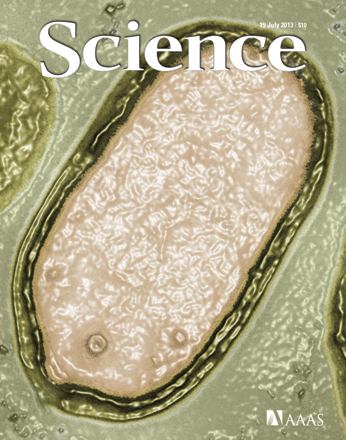
I had seen it on the web some weeks ago and I covered my ears and sang “lalala.” But now that I have it in front of me, smiling smugly from the cover of Science magazine, I cannot ignore the giant Pandoravirus and its acolytes anymore.

Electron microscopy image of teh huge virus pandora

Enhanced transmission electron microscopy image of a “Pandoravirus” particle, from the cover of Science, July 19 2013.

Gosh, maybe Patrick Forterre is right after all, and we have to rewrite the three domains and invite viruses in? Consider them alive?

Please note that I am NOT a virus expert and I do not follow the field. However I did come across Forterre’s work quite a while ago, found it fascinating, and immediately tried to forget. Put my head in the sand. Because I have been there before, facing a group of non-majors who have to take a general biology class because they have to. And they find everything about biology complicated and tiresome, and they look at their textbooks as the source of all wisdom and then one does the science thing. The days I am more pacific I purr softly “There are new developments that question some aspects of this theory,” and may leave it there. Other days I may try to transmit the enthusiasm of new discoveries in science that challenge old paradigms. But few students share the joy, especially if they just got something and then I am ruining it for them.

It is interesting how the perception of changes is different when inside or outside the field. Inside a field, one is aware of the small changes due to minor discoveries that eventually may lead to a complete reevaluation of the existing knowledge. As an outsider to the virus field, I have been seeing only bits and pieces of discoveries, which now suddenly seem to be moving in a certain direction.

So I’ll wait and see. I still remember years ago, when the idea that the microbes living on our body could do something else that just try to invade us given the chance was novel and revolutionary. I went from the casual comment of “it seems like gut microbes can influence obesity” to the current discussion of microbiomes and their importance in health and disease. Maybe in a few years, those slides with the neat 3 domains will become something very different.

This reflection is coming of course from my non-majors general bio class that started yesterday. Even during our SWI discussions last week it was obvious that non-majors require an extra dose of fun and excitement in a science class to make it somehow memorable. That’s why I decided to go for the Phelan book, for several reasons: it reads easier, it has a great companion website, it has tons of real life examples and applications, it has lots of graphing examples and illustrations, it is cheaper than the one we used before, and overall it just seems to be more fitting the modern student. I am also drawing heavily from the ideas and rubrics of the Vision and Change report, which identifies a set of core concepts and skills that should be part of the undergraduate biology education.  It is nice to have some solid guidelines for the design of coursework.

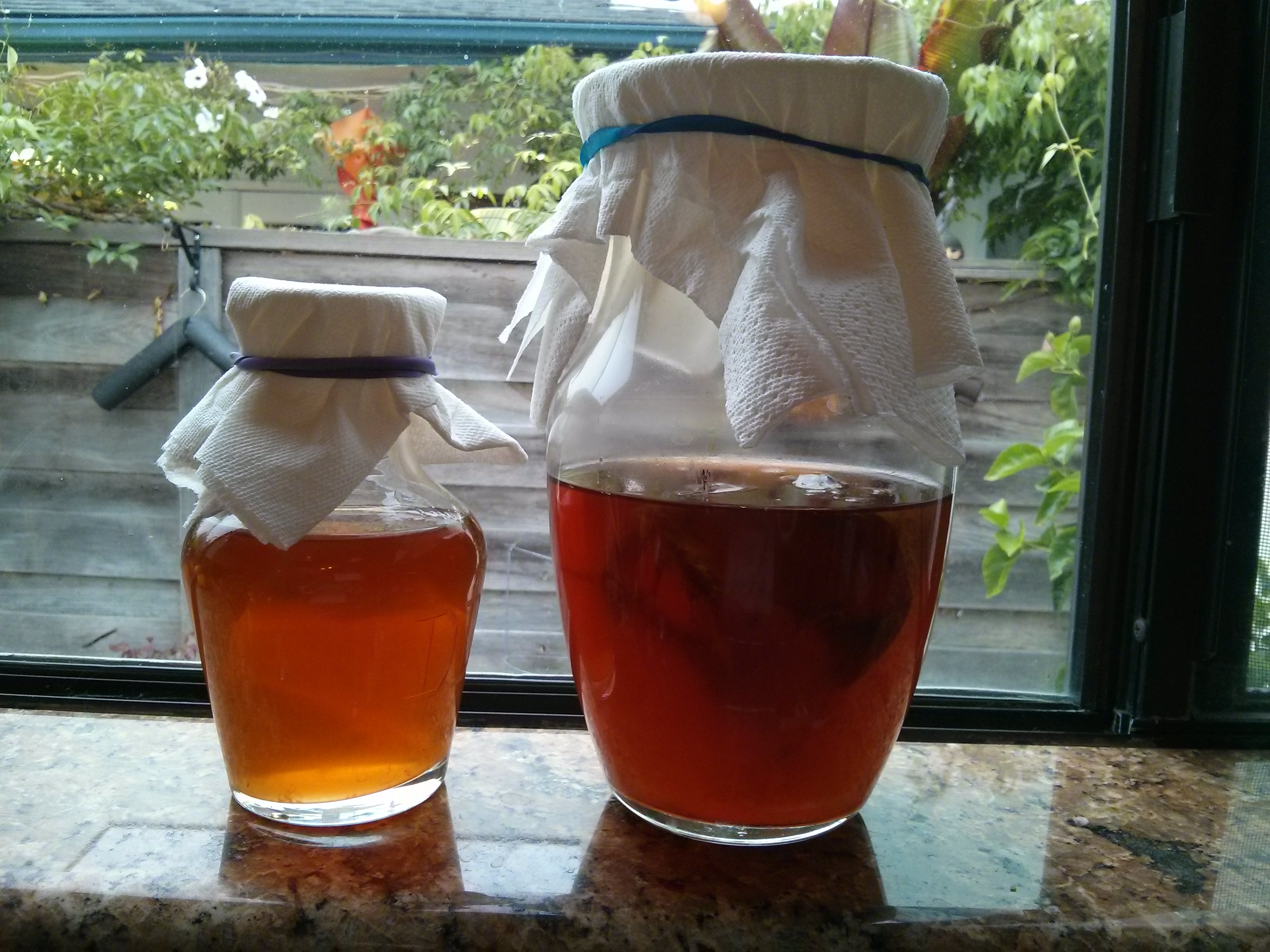
Two glass containers containing kombucha

My kombucha cultures, day 3.

The kombucha mothers, by the way, have risen to the surface of the sugary tea, not completely yet, but exposing more “body” to the air. What a relief. Following the instructions, I have been tasting the drink daily, feeling a slight tanginess invading the sweetness of the original tea. It is very pleasant, and it is amazing how quickly the pH changes day after day. It should not take many more days to get to the right balance point.

Other than that, lots of catching up to do after the SWI week. My cultures should arrive tomorrow to campus, but will have to wait until next week in the fridge as I am out of town this weekend…again. Stay tuned!

The unbearable fun of science

Leave a comment

Image

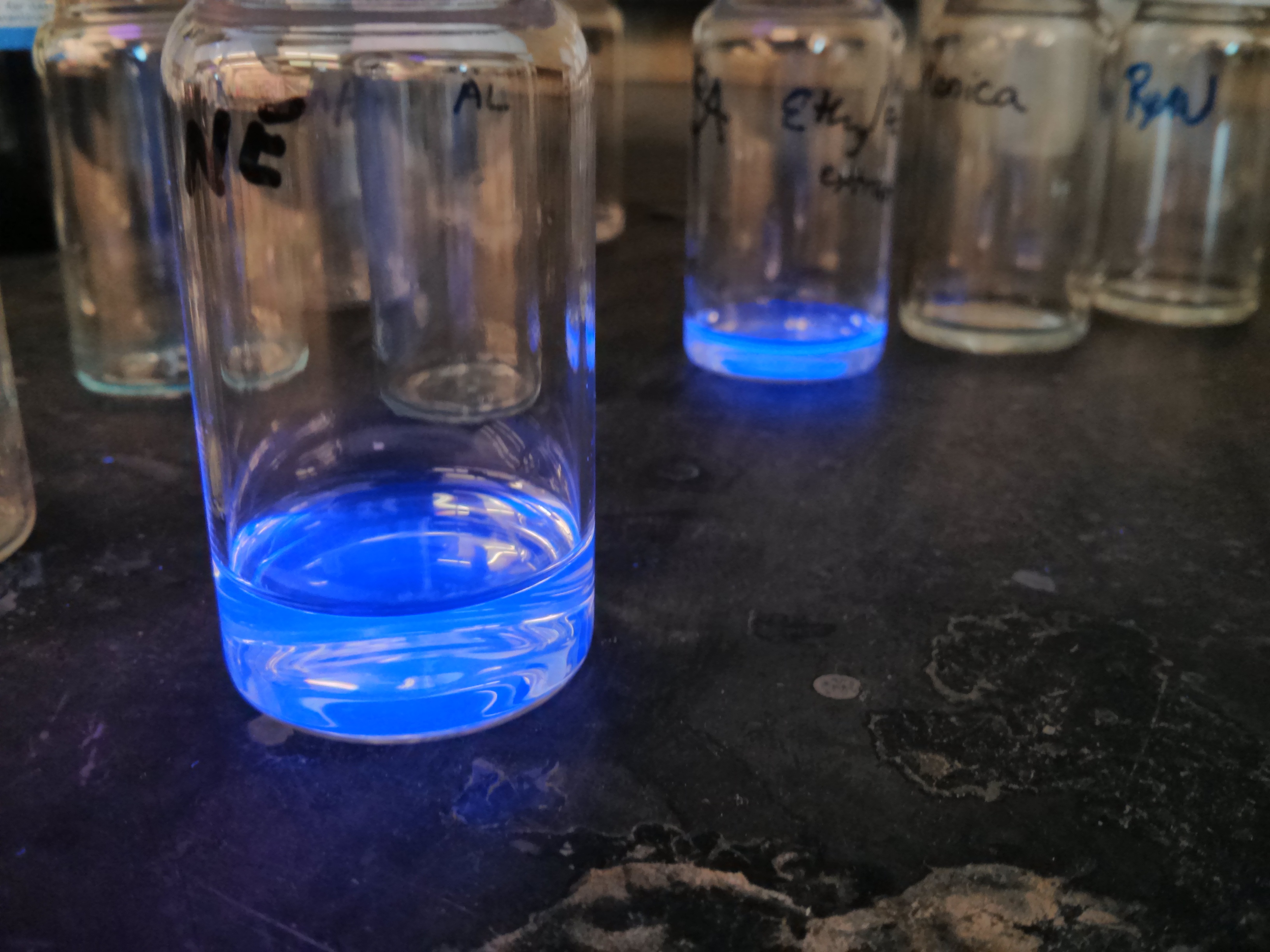
Some of our extracts under UV light.

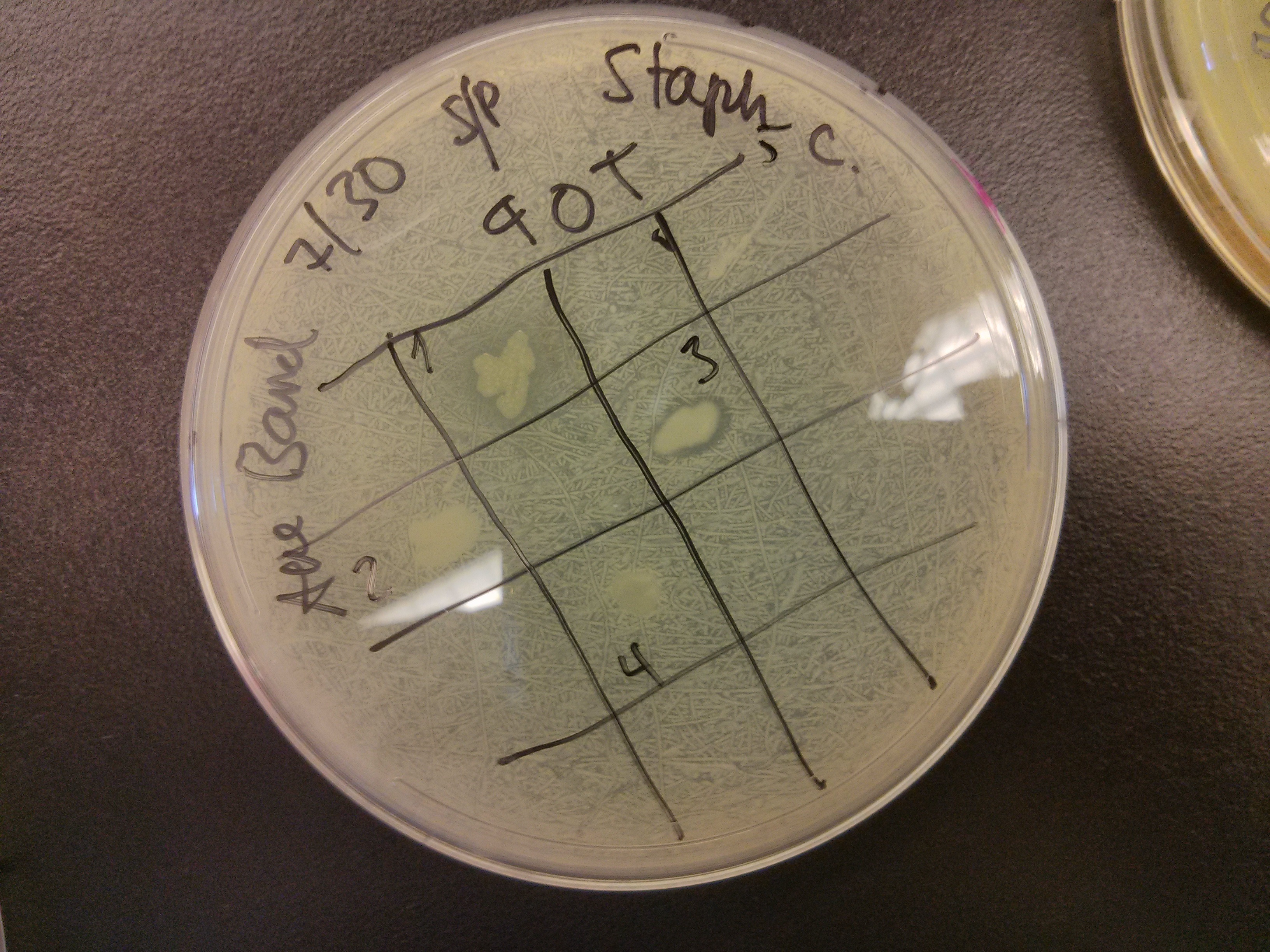
The Small World Initiative workshop has been galloping rapidly for the past 4 days. The group (24 biology educators from a variety of institutions) recreate the activities that students are to do in the prospective research course. The soil sample spread on the plates produced a number of colonies, pale bacterial ones that later became yellow or even fluorescent, intermingled with a haphazardly growing mucous bacillus whose name I have forgotten. We picked and patched, making master plates; and then spread and patched, confronting our colonies with harmless relatives of ESKAPE organisms (Enterococcus, Klebsiella, Pseudomonas, Acinetobacter, Staph, Enterobacter). We got all excited when discovering zones of inhibition, we retested, Gram-stained, did colony PCR to make a 16s sequencing, extracted with organic solvents, and as of today, we are eagerly awaiting the results of a spot assay of the aqueous phase against one of the bad guys.

Most of our time, however, is spent either in small groups developing our learning goals and objectives, as well as assessments; or sitting in a very cold big room to learn more about backward design, diversity, or IRB forms. The rest of the time we eat, and drink copious amounts of coffee or tea.

To make things more interesting, Jo Handelsman just became nominated for the position of Associate Director for Science, Office of Science and Technology Policy of the Administration. It is to the team’s credit that in spite of the news and all possible changes this may cause, things keep running smoothly. As smoothly as possible with 20 something scientists packed in a lab playing with microbes while learning new techniques. The course methodology incorporates such a variety of techniques, that most of us have something to learn.

The blog site I referred before is closed now for participants only, as we are uploading our working documents. There will be an official website with all the bells and whistles coming out in the near future.

Besides the workshop curriculum, we are learning lots from each other. We exchange ideas and tips, show each other techniques, software, apps, and tricks we use in research and teaching. I installed MEGA yesterday thanks to my roommate, and have been happily making little phylogenetic trees. Can’t wait for the sequence of my two finalists to come out.

And that is all for today. In a small scale (our workshop) we are having fun doing science and are worrying about how to make it happen home. In the large scale it is fun to think that somebody who knows science and science education well will be in such a high and responsible position. Personally, I hope that we are reaching a tipping point, where the powers to be realize that science education HAS to change and adapt to the realities of our century.

Is it time for dinner so soon?

2013-07-31 11.24.10

I can see some inhibition zones! Spread and patch plate.

Small World Initiative: quick intro

2 Comments

plate showing colonies growing

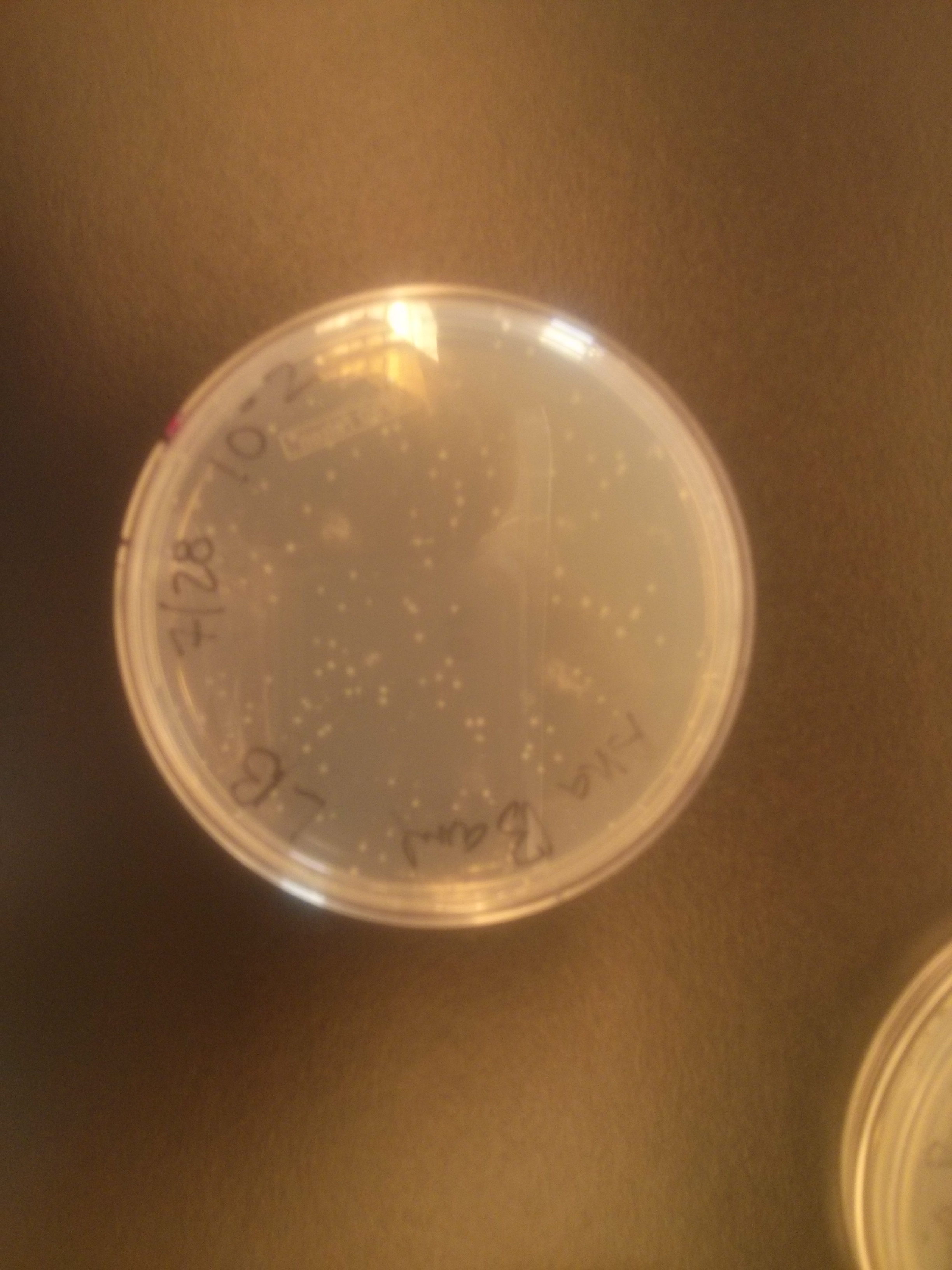
My soil sample on LB agar, 1/100 dilution

It is almost 10 pm and I am sitting in a student dormitory of Yale University, New Haven CT. My last post was from The Washington University in St. Louis, MO; in a ver similar setting. I am attending a workshop for professors to develop discovery-based lab courses.

For the record: I am here because my colleague who actually submitted the project could not attend. After the St. Louis workshop it was clear to me that driving such a project requires lots of work, and not only academic. But having our non-traditional university accepted as pilot partners is such an honor and opportunity, that I said yes when asked if I could jump in.

The initiative is driven by Jo Handelsman, whose work I have been following for a while. In real life she is even more amazing than on paper or the web. She is bright, focused, with a touch of humor and absolutely inspiring. She shared a personal history about why she felt so strongly about new antibiotics, which was moving; but also queried us on a simple chemical detail that could explain why big pharma companies have missed so many potential antibiotics. Then of course there is an amazing team, from Tiffany Tsang overseeing everything, to the poised education expertise of Jennifer Frederick and the solid laboratory knowledge of Simon Hernandez. There are more and they do more, but this is just day 2.

Tiffany created a great blog site: http://smallworldinitiative.wordpress.com/

where most of our documents are uploaded. This is also a site for ideas, comments, and general communication.

So far we have done some fun stuff in the lab: collected soil, made serial dilutions and prepared spread plates on different media. I was happy to see colonies on my LB plate today, and moved on to the next stage, pick and patch colonies. Next step will be testing for antibiotic activity, and then move on to characterization, PCR, and sequencing.

The rest of the time we sit and listen to lectures about science education, or discuss/brainstorm about the design of our future courses. While everybody is fired up, concerns abound about how to implement the courses, from time and space to powers to be. I feel very lucky that my university’s unorthodox system (one month accelerated courses in small classrooms) is actually pretty well suited for this project. We could probably make it easier in 2 months, but having long lab sessions 2-3 times/week (and nothing else) will probably make for an immersive experience. Not sure we will make it all the way to the chemical characterization of any possible compound, but it will be still amazing for our students.

This project is to be spread to the whole world…so we can explore soils everywhere in the search of new antibiotics. How cool can that be? Jo recalled that one of the richest student soil samples came from the town’s historical cemetery. Don’t you feel like going out to explore funky locations to sample soil?

I do.

Science is and has to be fun.

Consed or not consed…that is the question.

Leave a comment

2013-06-25 12.54.45

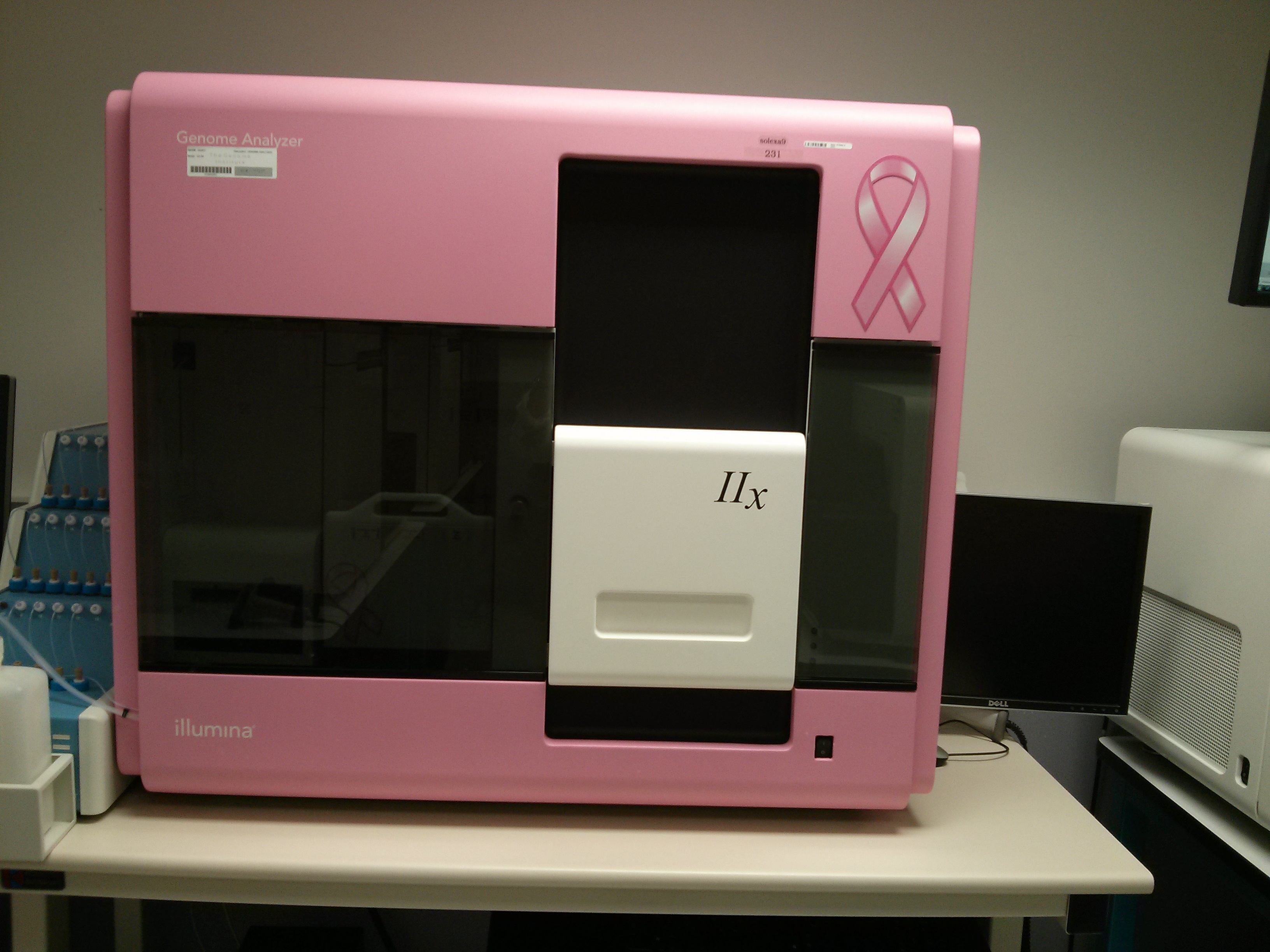
Pink DNA sequencer at the Genomics Institute in St. Louis.

Once upon a time, in my grad school years, I used to do a lot of microscopy of the fancier kind. At some point, that involved taking care of a deconvolution microscope and the associated Silicon Graphics computer running on Unix. I wanted to be prepared to handle that beast, so I talked to a fellow nerd, who recommended learning Linux. For a few months, I battled with Linux- I installed Red Hat, typed into terminal windows, and learned several commands. It helped a bit when the big machine arrived, but it was not really necessary, so I stopped trying. However, I did notice that it was a skill that impressed certain people.

That pride came rushing back today when we were introduced to Consed, one of the programs dedicated to sequence finishing. It needs to be started from a terminal window typing commands, so we received a short intro about Unix, and I felt pleased that I knew how to do it. It is one of those examples of pieces of knowledge acquired along the way of life.

Today we started officially the second part of the workshop. In the morning we had some free time to practice annotation, which was good. While there is still a long way to go, I could feel that I was getting more comfortable with the thinking behind the analysis, and my speed was hampered only by not remembering which link I had to click on to get the DNA sequence, or the predicted sequence, or whatever piece of information needed. The consensus of the group was that students will need some intense and extensive time to learn the system.

Screen shot 2013-06-25 at 3.18.33 PM

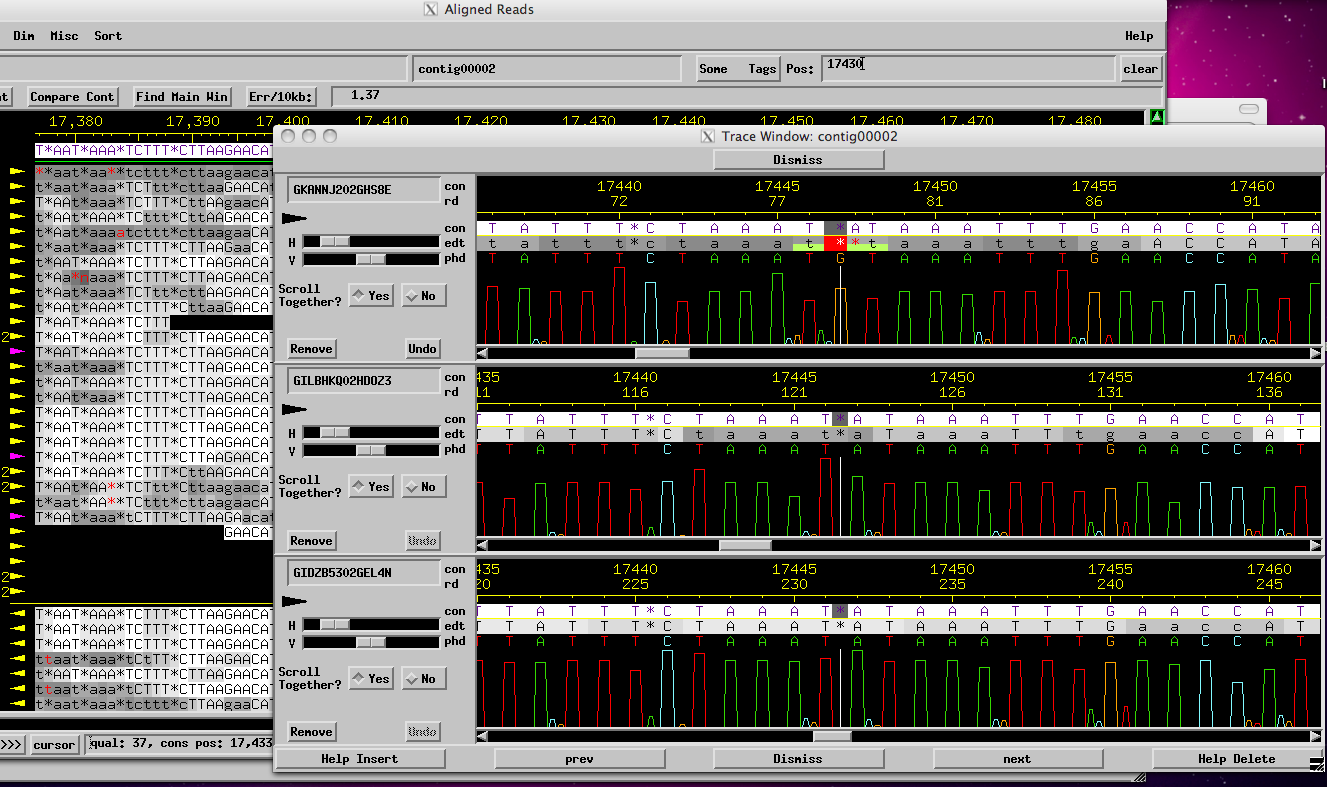
Consed screenshot.

Consed was introduced after we were given a tour of the Genomics Institution, an amazing building with amazing machinery and even more amazing science. We saw the famous pink sequencer, dedicated to the breast cancer genome project. We learned of all the projects the center is involved with, and the gigabytes of information generated weekly through next generation sequencing. Then we were introduced to Consed, and a group of young wizards gave a tutorial about how do they improve the raw sequences.

It was a whirlwind of windows to open, alignments, tracings, tags, comparisons, and decisions to make. However, the program is so visual, that after a while it became almost pleasing to solve the problems with the DNA sequences. Not sure why, maybe because it is more straightforward, but most of us in the group expressed they felt better today than yesterday.

The day flew by again- I get some exercise through a quick morning run in the Forest Park (a joy), otherwise the day is dedicated to work, work, work, with lots of food to sustain us; but we joke about the amount of glucose that we must spend with brain work in the cold cold air conditioned computer room! And it is time to go to sleep again- tomorrow is the last day!

2013-06-25 06.04.41

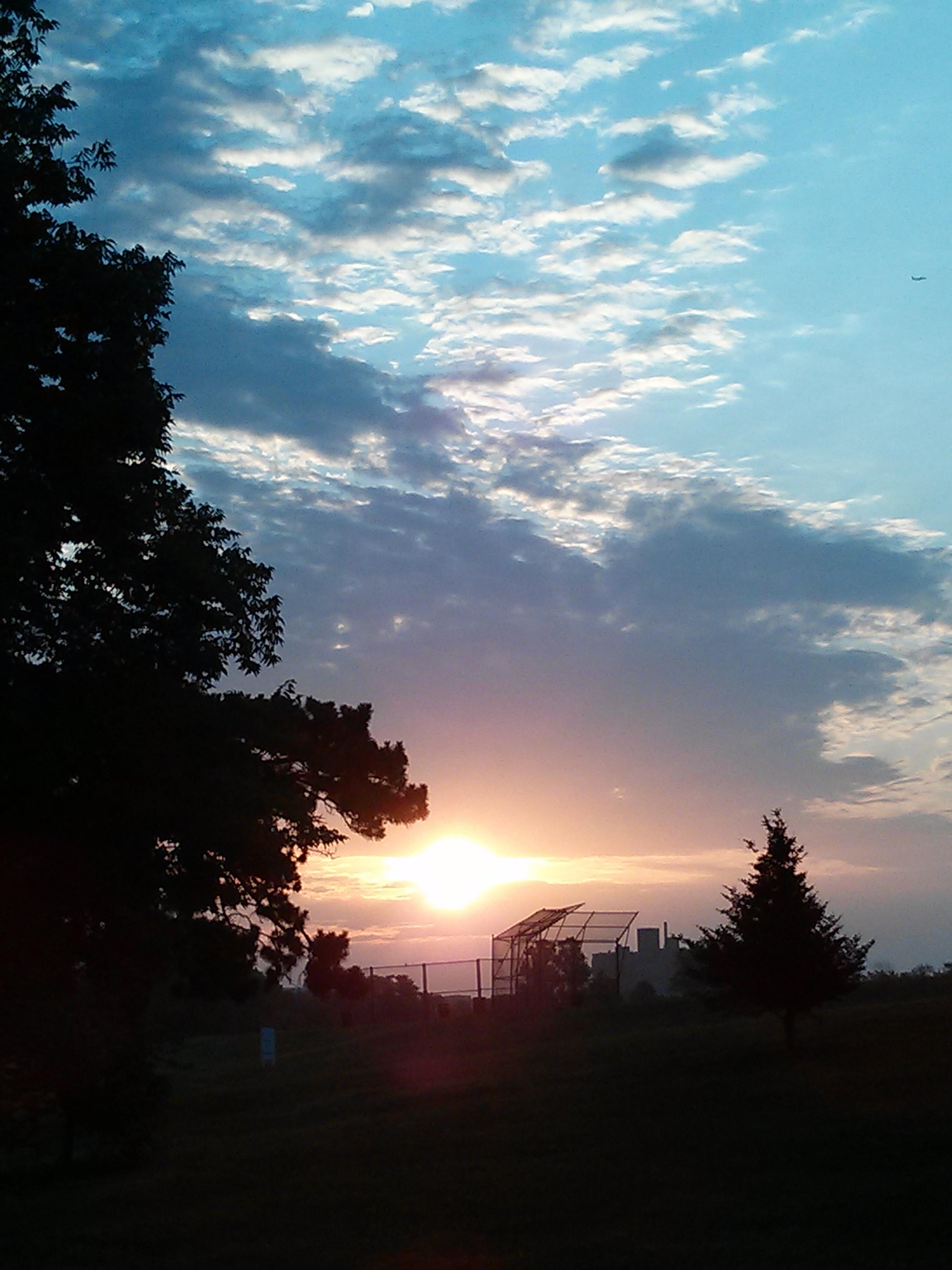
Sunrise over Forest Park.

Don’t believe everything you see or Blast

Leave a comment

Image

The Gateway Arch, according to my camera.

I was too tired last night to update the blog. After another intense day of annotation, discussions, and lectures, we did the must-do touristy thing in St. Louis: visiting the Gateway Arch. It was an impressive view, and then we had some fun in the group squeezing in the small trams resembling space capsules. From the top, the view was amazing, but a bit of a letdown as the windows were so small and the glass not so clean, so the pictures did not turn out stellar. While waiting in line, I played with the stitching feature of my new Nexus 4 phone. I love my phone, and I love the camera, but trying to pan a geometrically defined and narrow structure with unsteady hands standing in line was not easy. The picture you see here is one of my attempts to capture the magnificence of the structure.

The resulting picture connects directly to the message conveyed in the second day of the workshop, still dedicated to annotation: don’t believe everything the programs tell you.

We kept working on our sandbox projects, getting them ready for submission. In the meantime, we listened to presentations by GEP students, GEP faculty, and the usual lunch lecture by Sally Elgin. Every time we have a lecture, the computers in the room become shared, stopping us from use them in the meantime. While this system probably help people to concentrate on the presentation at hand instead of working with the sequence, it does limit sharing and updating. I keep my laptop open while taking notes in Endnote, and know better than to open any page other than the GEP, Flybase, or Blast 🙂

With some practice, the mechanics of annotation become easier, and eventually it becomes almost like a game. We were warned several times to not forget or let students forget science when looking at the results. We had a good lecture explaining how Blast works, and all the possible pitfalls of believing Blast too much, as the algorithm does its miscalculations. The value of RNA ref sequences was also discussed (may be for real or may be noise, depending on the quality of work, which end of the sequence it belongs to, or simply the kind of sequence it is). We got to know another database, Blat, and we were ushered back to look really closely to the sequence and THINK about what do those sequences actually mean in the evolutionary context.

The information overload continued with Sally Elgin’s lecture about the Drosophila chromosome 4 and its unique characteristics of having 80 genes (in melanogaster) in spite of having a prominent heterochromatin nature. There was an optional activity regarding chimpanzee sequences called Chimp Chunks, but I preferred to stay in the computer lab and fight my way through another sequence with multiple isoforms. The majority of participants I talked to expressed they felt better with annotation, but they thought they would dedicate some more time to annotate in the sandbox before moving on.

Today we get started with finishing, which seems rather intimidating. I hope to update with more info and links later on, but I need to rush for morning practice now. Until next time!

Annotation Day

Leave a comment

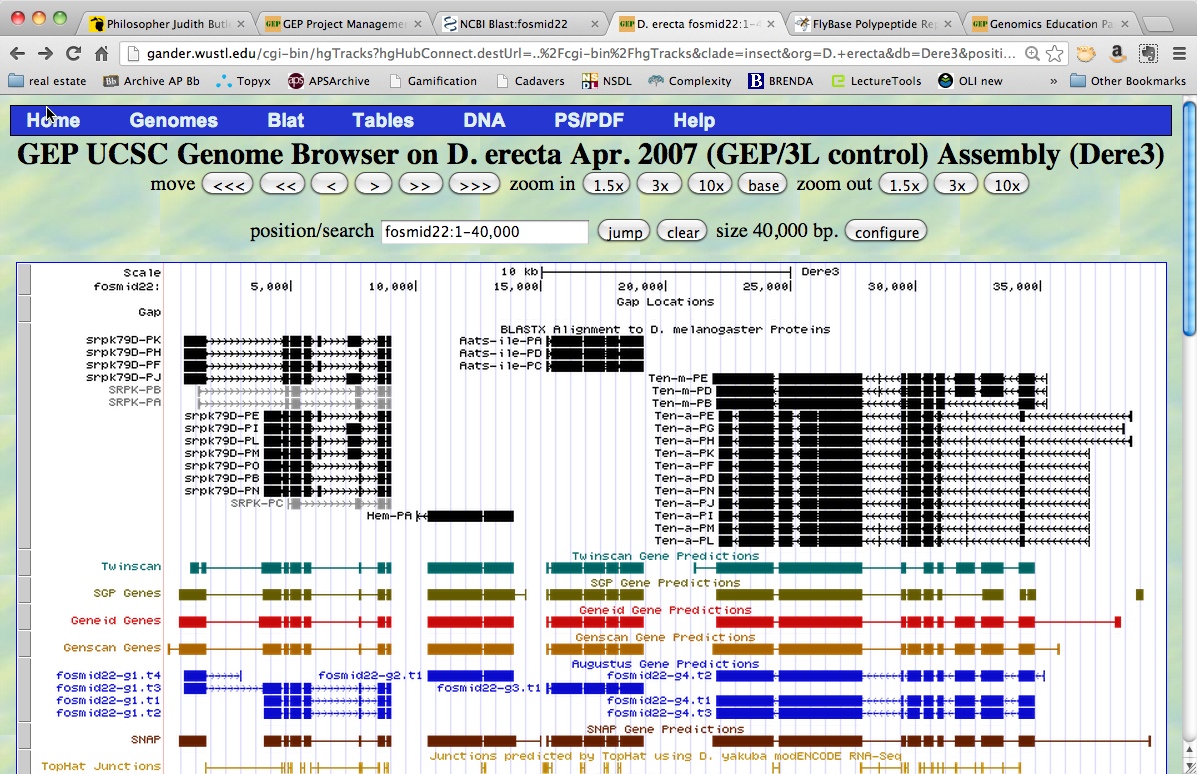
A screenshot from today's annotation.

A screenshot from today’s annotation.

Well, it is almost 11 pm and I am catching up with emails and blog posting at the hotel lobby. As Sally promised, the day was indeed intense. Once inside the computer lab of the Biology building, we sat down facing shiny large Apple displays (all analysis takes place on Macintosh computers, to some chagrin of the PC-only crowd) and started to crank. Actually we started with an intro lecture about annotation of Drosophila species, which is the first powerpoint here. This particular project is based on Drosophila, a model organism that I have never touched in my life except for illustration of some classic genetics concepts and experiments. But the way the project is designed, the workflow is applicable to other systems. We were given a basic annotation workflow suggestion:

  1. Identify the likely ortholog in D. melanogaster
  2. Determine the gene structure of the ortholog
  3. Map each exon of ortholog to the project sequence
  4. Use BLASTX to identify conserved region
    • note position and frame
  5. Use these data to construct a gene model
    • Identify exact start and stop base position for each CDS
  6. Use the Gene Model Checker to verify the gene model
  7. For each additional isoform, repeat steps 2-5

So we claimed fosmids containing genomic sequences from different Drosophila species,and started to play. The Gene Browser used is a mirror of the UCSC gene browser, once we get the alignment, we start to map the genes.

For me, newbie as I am to the whole business, it was amazing how real things become, once you are actually using the information to achieve a goal. For example, the realization that a piece of DNA has indeed 6 ways to be read, depending on the reading frame. That introns indeed exist and have to match the beginning and the end showing the donor (GT) and acceptor (AG) sequences. That codons can be interrupted by introns and one has to check, zooming in deep to the nucleotide level, that it is completed afterward. But as many said, the gamelike feeling of the beginning should be promptly corrected with the deep science behind those sequences. The biology, the conservation, the function of genes and the proteins they encode, are all aspects to be considered when annotating DNA.

I felt profound empathy with my students today. How many times, after going over some deep and complicated topic, I would give them 5 minutes to discuss and practice, and then move on to the next topic? I realize now how important is to pause, and give students time to go over the motions, to practice and just be able to process the information. Luckily we had breaks, and sometimes I just had to politely shoo away the helpful TAs. I needed time for myself, to try to do it on my own, and then ask questions.

There were discussions of many aspects of annotation today, how to handle gene families, repeats, and even transposable elements. I took notes, and asked questions. Luckily, I did not beat myself up choosing a too complicated assignment- I chose a relatively easy one, which gave me some satisfaction. I guess after some years brushing with teaching faculty I learned about scaffolding 🙂 Tomorrow will be another day…

The night ended (after dinner) with a discussion of possible ways of implementation. Many ideas were offered, from research courses to research retreats, or even modules in lower and upper level classes. My reflection was about how to incorporate this into a molecular bio or even gen bio class from day 0- start looking at real sequences from the moment the concepts are introduced. Maybe too steep a learning curve? I will have to think about a good strategy to implement. On the other hand, it could be part of an arc of application to the different levels of biological concepts from gene to protein.

And this is all for today, dear readers…am fading. Good night!

“No rest for the wicked…

1 Comment

and the righteous don’t need it!”

Image

Washington University in St. Louis

With those words ended Sally Elgin’s presentation last night kicking off the GEP workshop. After few hours of sleep, getting up at 4 am,and flying to St. Louis, my brain foggily registered that some very intense days were in front of the group. However, it is such an exciting possibility, especially by the combination of learning some cutting edge research techniques at such a prestigious university, together with a group of educators coming from a variety of schools, mostly small liberal arts colleges, community colleges, and like myself, a private non-profit. Even after such a short time we discussed similar issues: few resources, lots of courses to teach, a a strong desire to share with our students the experience and joy of research.

I am writing this at the breakfast table, in a hurry- we are heading for a full day of computer work with annotation, so I am not sure how much and how quickly I will be able to write. But for now, visit the course material page, from where most of the materials we will be using are.

Will be back soon!

Older Entries Newer Entries

about flexible, distance and online learning (FDOL)

FDOL, an open course using COOL FISh

WordPress VIP - The leading enterprise content platform

This multisite hosts public sites for Parse.ly and WordPress VIP

#Microjc

An Online Summer Book Club of Science

barralopolis

Teaching and learning reflections around science education

Disrupted Physician

The Physician Wellness Movement and Illegitimate Authority: The Need for Revolt and Reconstruction

The Blog of Author Tim Ferriss

Tim Ferriss is the author of five #1 New York Times bestsellers and host of The Tim Ferriss Show podcast.

Here is Havana

A blog written by the gringa next door

Storyshucker

A blog full of humorous and poignant observations.

Jung's Biology Blog

Teaching biology; bioinformatics; PSMs; academia, openteaching, openlearning

blogruedadelavida

Reflexiones sobre asuntos variados, desde criminologia hasta artes ocultas.

Humanitarian Cafe

Think Outside the Box

Small Pond Science

Research, teaching, and mentorship in the sciences

Small Things Considered

Teaching and learning reflections around science education

1 Year and a 100 Books

No two people read the same book